

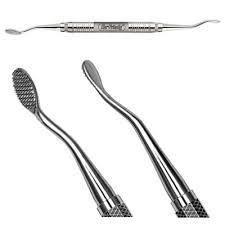

Selecting the Right Bone File for Your Practice
- Working End Design — Bone files feature serrated or rasp-like surfaces for efficient bone reduction. Coarser serrations remove bone quickly, while finer textures provide controlled finishing for smooth socket margins.
- Single vs Double-Ended Options — Double-ended instruments offer two working surfaces on one handle. This reduces instrument changes during procedures and provides versatility for different angulations and access points.
- Curved vs Straight Profiles — Curved bone files access posterior and anatomically complex areas more easily. Straight profiles work well for anterior regions and direct approach to buccal or lingual bone margins.
- Bone Scrapers for Harvesting — Bone scrapers collect autogenous bone chips during surgical procedures. The curved design allows efficient harvesting from cortical surfaces for grafting applications without separate instrumentation.
- Handle Ergonomics — Proper handle design reduces hand fatigue during bone contouring. Textured or knurled handles provide secure grip, essential when applying the controlled pressure needed for bone filing.
- Material and Sterilisation — Stainless steel construction withstands repeated autoclave cycles. Quality bone files maintain their cutting edges and corrosion resistance through standard steam sterilisation protocols.
Bone File Types at a Glance
| Instrument Type | Primary Function | Working End | Best Application |
|---|---|---|---|
| Standard Bone File | Bone smoothing | Serrated rasp surface | Post-extraction socket preparation |
| Miller Bone File | Interradicular bone removal | Narrow serrated tip | Septum removal between roots |
| Bone Scraper Curved | Autogenous bone harvest | Curved scraping edge | Collecting bone chips for grafting |
| Bone Rasp | Aggressive contouring | Coarse serrations | Ridge reduction procedures |
| Finishing Bone File | Final smoothing | Fine serrations | Creating smooth tissue bed |
How to Select Bone Files for Your Surgical Kit
- Assess your typical procedures: routine extractions need basic files, implant work requires finer instruments.
- Choose curved designs for posterior access and straight profiles for anterior sites.
- Consider bone scrapers if you perform grafting procedures requiring autogenous bone harvest.
- Verify stainless steel construction and autoclavable handles for infection control compliance.
- Order multiple sizes to handle varying clinical situations from single extractions to full arch work.
Availability & Delivery in Egypt
All bone files at MedSTA are priced in EGP with delivery available across Egypt. Store instruments in dry conditions away from humidity to maintain cutting edges between uses.
Frequently Asked Questions
What is the difference between a bone file and a bone rongeur?
What is the difference between a bone file and a bone rongeur?
Bone files smooth and contour bone with a rasping action, while rongeurs cut and remove bone pieces.
When should I use a curved bone scraper?
When should I use a curved bone scraper?
Use curved scrapers to harvest autogenous bone chips from cortical surfaces during grafting procedures.
How do I sterilise bone files?
How do I sterilise bone files?
Clean thoroughly after use and autoclave according to standard steam sterilisation protocols.
Can bone files be sharpened?
Can bone files be sharpened?
Most bone files cannot be resharpened effectively; replace when serrations become dull.
What size bone file should I start with?
What size bone file should I start with?
A medium-width file handles most routine extraction socket preparations effectively.
Are bone files used before or after extraction?
Are bone files used before or after extraction?
Typically used after extraction to smooth sharp bone edges before wound closure.
Do you deliver bone files throughout Egypt?
Do you deliver bone files throughout Egypt?
Yes, MedSTA delivers surgical instruments nationwide with all prices listed in EGP.