
 Up to 17% off
Taisier-med
Low stock (19 units)Sale price LE 225.00 EGP Regular price LE 270.00Unit price /Unavailable

Lux
Very low stock (3 units)Regular price LE 313.00 EGPUnit price /Unavailable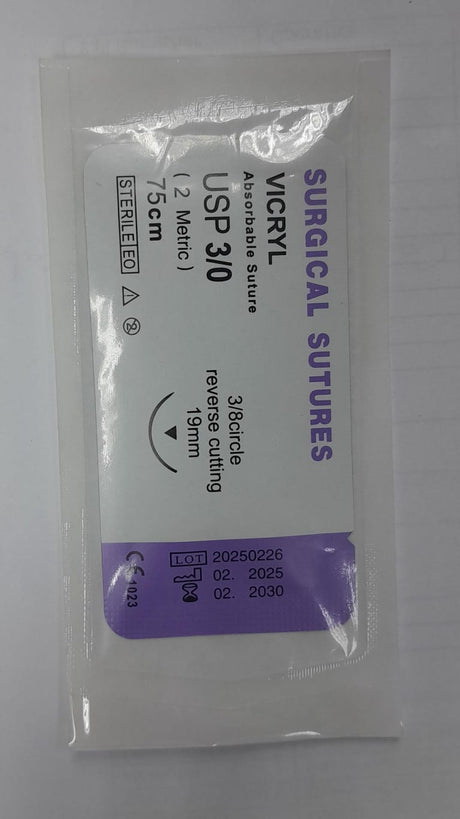
GENERIC
In stock (22 units)Regular price LE 675.00 EGPUnit price /Unavailable


How to Choose Dental Sutures for Oral Surgery and Periodontics
- Absorbable vs Non-Absorbable — Absorbable sutures (polyglactin 910 / Vicryl, PGA, catgut) resorb without requiring removal — appropriate for mucosal closures where follow-up is uncertain or patient compliance is low. Non-absorbable sutures (silk, nylon, polypropylene) require removal at 7–10 days but provide greater precision for periodontal flap margins and aesthetic closures where minimal scarring is critical.
- USP Size Selection — Size 3-0 (0.2 mm diameter) is standard for mucoperiosteal flap closure and post-extraction socket repair; 4-0 for periodontal surgery and finer gingival margins; 5-0 for microsurgical and aesthetic anterior cases. Larger sizes (2-0, 0) are used in maxillofacial and bone surgery closures not typically encountered in general dental practice.
- Needle Type (Reverse-Cutting vs Taper-Point) — Reverse-cutting needles (flat on the inner curve) resist tearing through dense mucoperiosteum during knot tying; taper-point needles minimize tissue puncture trauma in friable gingival tissue. Most oral surgery sutures use reverse-cutting needles for predictable mucosal penetration.
- Braided vs Monofilament Construction — Braided sutures (silk, Vicryl) have higher surface friction for knot security but wick bacteria in contaminated wounds. Monofilament sutures (nylon, polypropylene, poliglecaprone) resist wicking, are easier to clean around, and produce less tissue drag — preferred in periodontal surgery where plaque control around sutures is critical during the healing period.
- Suture Pad Practice — For dental students and junior clinicians in Egyptian training programmes, include a suture practice pad to develop and maintain knot-tying and tissue-approximation technique outside of clinical cases.
Suture Types Available at MedSTA Egypt
| Type | Material | Absorbable | Removal |
|---|---|---|---|
| Silk (black braided) | Natural protein | No | 7–10 days |
| Prolene (polypropylene) | Synthetic monofilament | No | 7–10 days |
| Vicryl (polyglactin 910) | Synthetic braided | Yes (56–70d) | Optional |
| PGA (polyglycolic acid) | Synthetic braided | Yes (60–90d) | Optional |
Availability & Delivery in Egypt
MedSTA supplies sutures from Taisier-med, Universal Sutures, and Assut Sutures across all absorbable and non-absorbable types, priced in EGP. Same-day dispatch from Cairo; Cairo and Giza delivery within 1–3 business days and all other Egyptian governorates within 3–5 business days.
Frequently Asked Questions
What is the most commonly used suture for dental extraction wound closure in Egypt?
What is the most commonly used suture for dental extraction wound closure in Egypt?
Black braided silk 3-0 remains the most widely used suture for routine extraction socket closure in Egyptian dental practice due to its low cost, excellent knot security with 3–4 throws, good tissue handling, and wide availability. It requires removal at 7–10 days. For patients where follow-up cannot be guaranteed — common in Egyptian public hospital settings — a 3-0 absorbable suture (polyglactin 910 or PGA) is preferred to avoid the consequences of an unremoved silk suture.
When should I use an absorbable suture instead of silk for oral surgery?
When should I use an absorbable suture instead of silk for oral surgery?
Use absorbable sutures when: (1) patient follow-up for suture removal is uncertain or the patient lives in a distant Egyptian governorate; (2) the wound is in an area where suture removal would be technically difficult (deep sulcular access in periodontal surgery); (3) the patient has a needle phobia or is very anxious about the removal appointment. Use silk or nylon when maximum precision of wound edge apposition is needed during the healing period and suture removal is guaranteed at 7–10 days.
How do I know when sutures should be removed after oral surgery?
How do I know when sutures should be removed after oral surgery?
Remove non-absorbable sutures (silk, nylon, polypropylene) 7–10 days post-procedure in routine extraction and implant cases. For periodontal flap surgery, remove at 10–14 days to allow more complete epithelialisation of the wound edge before removing the suture that is holding flap position. Signs of early suture removal: wound edges separated but tissue is granulating normally — leave sutures; signs of delayed removal: suture is embedded in healed tissue — remove immediately to prevent suture granuloma formation.
How should dental sutures be stored in Egyptian clinics during summer?
How should dental sutures be stored in Egyptian clinics during summer?
Store suture packs at 15–25°C in a dry environment away from direct sunlight. In Egyptian summer (30–42°C ambient without climate control), the polymers in synthetic absorbable sutures (Vicryl, PGA) degrade faster via ambient humidity-induced hydrolysis, reducing tensile strength before clinical use. Store sutures in a sealed cabinet with silica gel desiccant if climate control is not available, and always check expiry dates before use. Silk sutures are more heat-stable but should also be kept cool and dry.
Does MedSTA supply dental sutures from Taisier-med and international brands across Egypt?
Does MedSTA supply dental sutures from Taisier-med and international brands across Egypt?
Yes — MedSTA supplies black silk sutures, Prolene polypropylene sutures, Vicryl polyglactin, and PGA sutures from Taisier-med, Universal Sutures, Assut Sutures, and generic brands in EGP. Same-day dispatch from Cairo; Cairo and Giza delivery within 1–3 business days and all other Egyptian governorates within 3–5 business days.