
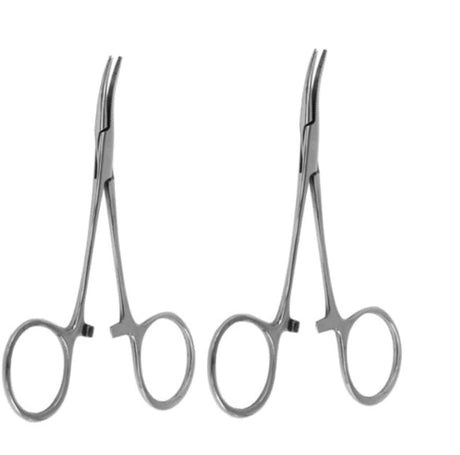
GENERIC
Low stock (18 units)Regular price LE 85.00 EGPUnit price /Unavailable
How to Choose Dental Mosquito Forceps for Oral Surgery
- Straight vs Curved — Straight mosquito forceps access anterior surgical sites and maxillary vestibule areas with direct visual access; curved (Halsted-type) mosquito forceps reach posterior regions and deep surgical cavities where straight-line instrument access is obstructed. Most oral surgical kits include both straight and curved pairs for complete access across all anatomical areas.
- Jaw Length (Mosquito vs Kelly vs Rochester-Pean) — Mosquito clamps have the shortest jaw (20 mm) for fine tissue control and small vessel clamping; Kelly clamps have longer jaws (30 mm) for larger tissue bundles; Rochester-Pean clamps have fully serrated jaws for maximum grip on larger vessels. In dental practice, mosquito clamps are most appropriate for the fine tissue work encountered in flap surgery and implant placement.
- Serration Pattern (Transverse vs Longitudinal vs Horizontal) — Horizontal (transverse) serrations grip tissue perpendicular to the jaw axis, providing strong haemostatic clamping; longitudinal serrations grip tissue along the jaw axis for gentle traction without crushing. Mosquito clamps use horizontal serrations for haemostasis; the fine teeth must align precisely across both jaw surfaces for reliable clamping.
- Box Joint Quality — The box joint hinge must allow smooth opening and ratchet closure without lateral play or wobble; a loose hinge reduces clamping force and causes inaccurate tissue alignment during closure. Inspect hinge tightness before purchasing; premium instruments (Sedra dent) maintain consistent hinge tension through 300+ autoclave cycles.
- Steel Grade (AISI 420 for dental surgical instruments) — AISI 420 martensitic stainless steel provides the hardness required for precise ratchet engagement and jaw serration durability; softer AISI 304 austenitic steel is used in some budget instruments but yields under repeated closure force, degrading ratchet engagement reliability.
Dental Mosquito Forceps Available in Egypt
| Product | Jaw Shape | Length | Price (EGP) |
|---|---|---|---|
| Dental Mosquito Forceps (Generic) | Curved | Standard | 85 |
| Sedra Curved Mosquito Forceps | Curved | 14 cm | 350 |
Availability & Delivery in Egypt
MedSTA supplies dental mosquito forceps from Sedra dent and generic brands in EGP with same-day dispatch from Cairo. Cairo and Giza delivery within 1–3 business days; all other Egyptian governorates within 3–5 business days.
Frequently Asked Questions
What is the clinical role of mosquito forceps in dental surgery?
What is the clinical role of mosquito forceps in dental surgery?
In dental oral surgery, mosquito forceps serve three primary roles: (1) haemostasis — clamping small vessels (e.g. the mental artery during anterior implant flap reflection) before ligation or cauterisation; (2) tissue retraction — grasping and holding the free edge of a reflected mucosal flap during suturing in confined posterior access sites; (3) instrument transfer — passing suture needles and ligatures between the assistant and surgeon in a sterile manner during suture placement. They are not used for tooth or root fragment grasping — that requires extraction forceps.
How are mosquito forceps different from dental tweezers?
How are mosquito forceps different from dental tweezers?
Dental tweezers (cotton forceps) are spring-loaded instruments that hold items between their jaws only when finger pressure is applied and release automatically when pressure is relaxed — appropriate for picking up cotton pellets and small materials. Mosquito forceps have a ratchet locking mechanism that clamps and holds tissue or vessels without sustained finger pressure, maintaining haemostatic clamping force while the surgeon uses both hands for other tasks. The two instruments are not interchangeable despite both looking like forceps.
Can mosquito forceps be used to clamp bleeding vessels after tooth extraction?
Can mosquito forceps be used to clamp bleeding vessels after tooth extraction?
Yes — in cases of post-extraction haemorrhage from a visible vessel (e.g. damaged inferior alveolar artery branch in third molar surgery), mosquito forceps can be used to clamp the vessel before ligation with a suture or electrosurgical coagulation. The curved jaw allows access to deep socket bleeding points. However, blind clamping in a blood-filled socket without visual identification of the vessel carries risk of inadvertent nerve clamping — achieve haemostasis by direct pressure and suturing first; reserve vascular clamping for clearly identified bleeding points under direct vision.
How should dental mosquito forceps be sterilised?
How should dental mosquito forceps be sterilised?
Autoclave mosquito forceps with the ratchet in the open (un-locked) position to allow steam penetration into the jaw serrations and hinge area. Locking the ratchet during autoclaving prevents full steam circulation between the jaw faces and increases residual moisture trapped in the serration grooves. Before autoclaving, clean in an ultrasonic bath with enzymatic detergent, inspect jaw alignment, dry, lubricate the hinge pivot, pouch, and autoclave at 134°C, 3 bar. Inspect ratchet engagement after every 50 cycles; replace if any ratchet skip is detected.
Does MedSTA supply dental mosquito forceps across Egypt?
Does MedSTA supply dental mosquito forceps across Egypt?
Yes — MedSTA supplies generic curved mosquito forceps (85 EGP) and Sedra dent curved mosquito forceps 14 cm (350 EGP) in EGP with same-day dispatch from Cairo. Cairo and Giza delivery within 1–3 business days; all other Egyptian governorates within 3–5 business days.