
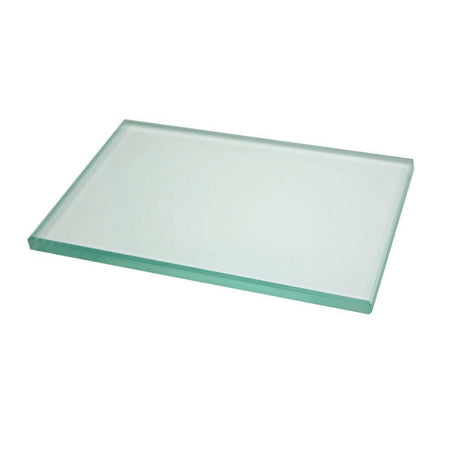
How to Choose Dental Glass Slabs for Cement Mixing
- Glass Thickness (6 mm vs 10 mm) — Thicker 10 mm glass slabs retain cold more effectively than thin 6 mm slabs; for zinc phosphate cement mixing, a cold glass slab (refrigerated to 4–6°C) is mandatory to extend working time by slowing the exothermic reaction. Thin slabs warm up faster from the cement’s reaction heat, reducing the effective working time advantage of cold mixing.
- Surface Finish (Polished vs Frosted) — Polished (clear) glass allows complete cement removal by scraping; frosted or etched surfaces trap cement residue in micro-surface irregularities, making cleaning difficult and potentially contaminating the next mix. Always use smooth, polished glass slabs for cement mixing and replace when surface scratches accumulate.
- Size (7.5 cm × 7.5 cm vs 10 cm × 10 cm) — Standard-size slabs (7.5 cm × 7.5 cm) are adequate for single-unit cementation mixes; larger slabs (10 cm × 10 cm) are required for bridge cementation and when multiple mixing increments need to be spatulated in sequence without overlapping and contaminating adjacent mix portions.
- Dedicated vs Multi-Purpose Use — Dedicate separate glass slabs to different cement types; zinc phosphate cement residue interferes with GIC setting chemistry if the slab is not completely clean between mixes. Label slabs by cement type (one for ZnPO4, one for GIC, one for ZOE) or clean by autoclaving between cement types rather than attempting surface cleaning between uses.
- Autoclave Compatibility — Standard borosilicate glass slabs withstand autoclave cycles at 134°C without cracking provided they are allowed to equilibrate to room temperature before the cycle begins. Rapid thermal shock (placing a cold slab directly into a hot autoclave) causes glass cracking. Handle carefully — glass slabs are brittle and chip easily at the edges if dropped.
Availability & Delivery in Egypt
MedSTA supplies dental glass slabs in EGP with same-day dispatch from Cairo. Cairo and Giza delivery within 1–3 business days; all other Egyptian governorates within 3–5 business days. Suitable for prosthodontic, restorative, and endodontic cement mixing in Egyptian dental clinics.
Frequently Asked Questions
Why must the glass slab be cold for zinc phosphate cement mixing?
Why must the glass slab be cold for zinc phosphate cement mixing?
Zinc phosphate cement sets through an exothermic acid-base reaction between zinc oxide powder and phosphoric acid liquid. The reaction rate (and heat evolution) is temperature-dependent; cooling the glass slab to 4–6°C (from a refrigerator) slows the reaction kinetics, extending working time from approximately 2 minutes at room temperature to 4–5 minutes on a cold slab. This allows the operator to spatulate more powder increments into the liquid in a controlled manner, producing a lower-film-thickness cement mix (25–30 µm) than is achievable without cold mixing.
Can the same glass slab be used for GIC and zinc phosphate cement mixing?
Can the same glass slab be used for GIC and zinc phosphate cement mixing?
Technically yes, if the slab is completely cleaned between cement types, but the risk of cross-contamination is high if cement residue remains in surface micro-scratches. Zinc phosphate acid residue on the slab surface dramatically accelerates GIC setting and reduces working time; GIC powder on the slab contaminates the next zinc phosphate mix. Best practice: dedicate separate labeled glass slabs to each cement type. This is an inexpensive precaution given the low unit cost of glass slabs (7 EGP) relative to the cost of a failed cementation requiring crown removal and re-cementation.
How do I clean a glass slab after cement mixing?
How do I clean a glass slab after cement mixing?
Immediately after use (before cement sets), scrape residual cement from the slab with a clean spatula and wipe with a damp gauze. For set cement residue, soak the slab in water for 2–5 minutes to dissolve GIC and ZOE residue, then scrape clean. Zinc phosphate cement residue may require brief soaking in weak citric acid solution. Autoclave the clean slab before the next clinical use. Never use abrasive scrubbing pads that scratch the surface — scratched slabs retain cement particles and should be replaced.
Are glass slabs being replaced by paper mixing pads in Egyptian dental practice?
Are glass slabs being replaced by paper mixing pads in Egyptian dental practice?
Disposable paper mixing pads are increasingly used for GIC, resin-modified GIC, and temporary cement mixing in Egyptian practices, as they eliminate the cleaning and sterilisation step. However, glass slabs remain essential for zinc phosphate cement mixing where surface temperature control (cold slab) is clinically necessary and where the precise spatulation required for low-film-thickness cement production is best achieved on a non-absorbent surface. Paper pads absorb some liquid, altering the powder-liquid ratio of zinc phosphate cement mixes.
Does MedSTA supply dental glass slabs across Egypt?
Does MedSTA supply dental glass slabs across Egypt?
Yes — MedSTA supplies dental glass mixing slabs in EGP with same-day dispatch from Cairo. Cairo and Giza delivery within 1–3 business days; all other Egyptian governorates within 3–5 business days. Contact MedSTA for bulk pricing for Egyptian dental faculties and multi-chair clinical practices.