
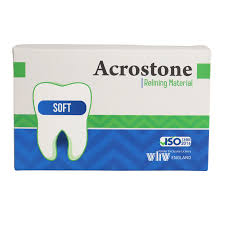
Acrostone
Very low stock (1 unit)Regular price LE 1,375.00 EGPUnit price /Unavailable
How to Choose the Right Denture Relining Materials for Your Practice
- Hard reline vs soft liner — Hard relining replaces the tissue-fitting surface with new PMMA cold-cure or heat-cure resin, restoring full ridge support and vertical dimension. Soft liners (Shore A 10–40 durometer) are indicated where ridge atrophy causes pressure soreness under hard acrylic — they absorb occlusal forces and redistribute pressure across a wider tissue area.
- Chairside vs laboratory soft liner — Chairside soft liners (acrylic-based, e.g. Acrostone Soft Liner) set directly in the mouth in 3–5 minutes, allowing same-session delivery. Laboratory-processed silicone liners have superior durability (Shore A stability >12 months vs 3–6 months for chairside acrylic liners) but require an additional appointment.
- Adhesion to base resin — Acrylic-based soft liners bond chemically to PMMA denture bases without adhesive. Silicone liners require a dedicated primer on the cleaned acrylic surface — failure to prime reduces bond strength and causes delamination, a common failure mode in Egyptian clinics with high-use denture patients.
- Relining vs rebasing indication — Reline only the fitting surface when the denture base has sufficient structural integrity. Rebasing (replacing the entire base) is indicated when the base is excessively thinned, fractured, or warped. Rebase always requires laboratory processing — chairside acrylic alone cannot replicate the strength of a fully processed base.
- Egyptian summer storage — Chairside soft liner monomers degrade above 25°C — store sealed at 4–10°C. Heat-exposed monomer loses working time and produces a more porous, less durable reline that delaminates prematurely under masticatory forces.
Relining Material Types at a Glance
| Material | Type | Setting | Durability | Best For |
|---|---|---|---|---|
| Acrostone Soft Liner | Acrylic-based soft liner | Chairside, 3–5 min | 3–6 months | Immediate soft tissue relief, resorbed ridges |
| Hard cold-cure PMMA reline | Self-curing PMMA | Chairside, 20–30 min | >5 years | Ridge support restoration, VDO correction |
| Silicone soft liner (lab) | RTV silicone | Laboratory only | >12 months | Long-term soft liner where lab access is available |
| Tissue conditioner | Plasticised PMMA | Chairside, immediate | 1–2 weeks | Temporary tissue recovery before definitive reline |
Availability & Delivery in Egypt
MedSTA supplies Acrostone soft liners and denture repair resins in EGP, with same-day dispatch for Cairo and Giza and 2–5 day delivery to all Egyptian governorates. Products are packaged to preserve monomer quality through Egypt's summer transit temperatures.
Frequently Asked Questions
What is the difference between a soft liner and a hard reline for denture relining?
What is the difference between a soft liner and a hard reline for denture relining?
A hard reline replaces the tissue-fitting surface with new cold-cure or heat-cure PMMA, restoring full ridge contact and structural support — the appropriate choice when the denture base is intact but no longer fits due to ridge resorption. A soft liner (Shore A 10–40) is a resilient, cushioning layer indicated when patients experience pressure soreness under hard acrylic — it distributes masticatory forces over a wider tissue area, reducing focal loading on atrophic ridges.
Can a soft liner be applied chairside or does it always require laboratory processing?
Can a soft liner be applied chairside or does it always require laboratory processing?
Acrylic-based soft liners such as Acrostone Soft Liner can be applied chairside in a single appointment — the material is mixed, applied to the fitting surface, and the patient bites into occlusion until the liner sets (3–5 minutes). Silicone-based soft liners require laboratory processing with a dedicated primer, flask, and curing cycle, providing longer service life (>12 months) in exchange for an additional appointment.
How long does a soft liner last before replacement in Egyptian dental clinics?
How long does a soft liner last before replacement in Egyptian dental clinics?
Chairside acrylic-based soft liners typically remain serviceable for 3–6 months under normal masticatory forces. In Egyptian conditions — where summer ambient temperatures accelerate monomer outgassing and higher dietary abrasives increase surface wear — replacement may be needed closer to 3 months. Patients should be recalled to assess surface roughness, adhesion integrity, and fit change at each soft-liner review appointment.
What type of repair resin is needed to re-bond a broken artificial tooth to a full denture?
What type of repair resin is needed to re-bond a broken artificial tooth to a full denture?
For re-bonding a fractured or displaced acrylic tooth to a full denture, cold-cure PMMA repair resin is the standard approach. The broken surfaces are lightly abraded, air-dried, and monomer is applied as a bonding agent before the repair resin is placed. For PMMA sheet teeth, this produces a chemical bond similar to the original bond. Composite teeth may require a specific bonding adhesive due to their cross-linked polymer matrix, which does not bond as readily to PMMA monomer alone.
Does MedSTA supply Acrostone soft liners and relining materials to dental practices across Egypt?
Does MedSTA supply Acrostone soft liners and relining materials to dental practices across Egypt?
Yes. MedSTA supplies Acrostone soft liners and related denture repair materials in EGP, with nationwide delivery to Cairo, Giza, Alexandria, Mansoura, and all other Egyptian governorates. In-stock items are dispatched with same-day processing from MedSTA's Cairo warehouse.