

Mani
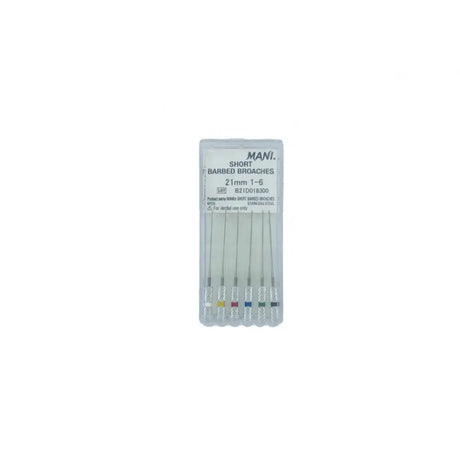
Mani Nerve Broaches 21 mm #1-6
Very low stock (8 units)Regular price LE 150.00 EGPUnit price /Unavailable
How to Choose and Use Dental Broaches Correctly
- Barb Design and Function (Extirpation Only) — Barbed broaches are wire instruments with sharp lateral barbs stamped along the shaft that engage and withdraw pulp tissue when rotated and pulled. They do not cut dentine and are never used for canal shaping. The most common clinical error with broaches is using them as if they were files — this leads to instrument separation and unintentional dentine damage.
- Size Selection (#1–#6) — Select a size at least one category smaller than the estimated canal diameter to allow passive insertion without engaging canal walls during insertion. For a narrow anterior canal, start with a small size (#1–2); for a wider premolar or molar canal, a medium size (#3–4) is appropriate. The broach should slide in freely — any resistance before two-thirds depth indicates a size that is too large.
- Passive Insertion Technique — Insert passively (without rotational force) to approximately two-thirds of working length. Do not advance to full working length — this risks locking the barbs into the apical dentine. Once at two-thirds depth, rotate one-quarter to one-half turn clockwise to engage pulp tissue, then withdraw in a single smooth motion.
- Fracture Prevention — Broach separation is the most common instrument fracture in endodontics. Prevention: always select a size smaller than the canal, never apply downward force if resistance is felt, and withdraw in a single smooth movement. If a broach locks, rotate slightly anticlockwise to disengage before withdrawing.
- Single vs Multi-Use Protocol — Broaches can be autoclaved and reused for 3–5 uses in clean canals. For infected, necrotic, or heavily haemorrhagic cases, discard after single use. Discard immediately if any barb is visibly flattened or the wire is bent after inspection.
Broach Size Selection Guide
| Size | Canal Application | Typical Tooth Type | Insertion Depth |
|---|---|---|---|
| XS – S (#1–#2) | Narrow canal, initial access | Mandibular anterior, narrow incisors | Two-thirds WL |
| M (#3–#4) | Standard premolar/anterior | Upper anteriors, upper premolars | Two-thirds WL |
| L – XL (#5–#6) | Wider canals, initial debridement | Wide upper incisors, molar orifice | One-half WL |
Availability & Delivery in Egypt
MedSTA stocks dental broaches from Medin, Poldent, Mani, and other trusted brands, priced from 145–160 EGP per 10-piece pack, delivered to endodontic and general practices across Cairo, Giza, Alexandria, and all Egyptian governorates. Store in dry conditions — barb surfaces are susceptible to surface corrosion if exposed to moisture before use.
Frequently Asked Questions
What is the difference between a barbed broach and an endodontic file?
What is the difference between a barbed broach and an endodontic file?
A barbed broach is a wire instrument with lateral barbs used exclusively for pulp extirpation and removal of cotton or paper points from the canal — it does not cut dentine and must not be used for canal shaping. Endodontic files (K files, H files, rotary NiTi) are shaped instruments for canal preparation. Using a broach as a filing instrument is the most common cause of broach separation in Egyptian endodontic practice.
How is a barbed broach correctly used for pulp extirpation?
How is a barbed broach correctly used for pulp extirpation?
Select a broach at least one size smaller than the canal diameter to allow passive insertion. Insert to two-thirds of working length without force — resistance before this depth means the broach is too large. Rotate one-quarter to one-half turn clockwise to engage pulp tissue in the barbs, then withdraw in a single smooth motion. Repeat with fresh broaches until withdrawal shows no tissue.
Can dental broaches be sterilized and reused between patients?
Can dental broaches be sterilized and reused between patients?
Yes, broaches are autoclavable and can be reused for 3–5 uses in clean canals. For infected, necrotic, or heavily haemorrhagic cases, discard after single use — barb recesses are difficult to fully decontaminate. Discard immediately if any barb is visibly flattened, the wire is bent, or insertion resistance was felt during the previous use.
What size broach should I use for a standard upper anterior canal?
What size broach should I use for a standard upper anterior canal?
For a standard upper anterior (central or lateral incisor) with a moderate-width canal, a medium size broach (#3–#4) inserted to two-thirds working length is appropriate. If the broach binds before two-thirds depth, select one size smaller. Never force any broach apically — the barbs lock into dentinal walls and the wire will separate under tension.
Does MedSTA deliver dental broaches to endodontic practices across Egypt?
Does MedSTA deliver dental broaches to endodontic practices across Egypt?
Yes. MedSTA delivers dental broaches from Medin, Poldent, Mani, and other brands to endodontic and general practices across Cairo, Giza, Alexandria, and all Egyptian governorates, priced in EGP with fast nationwide delivery.