
dentkist
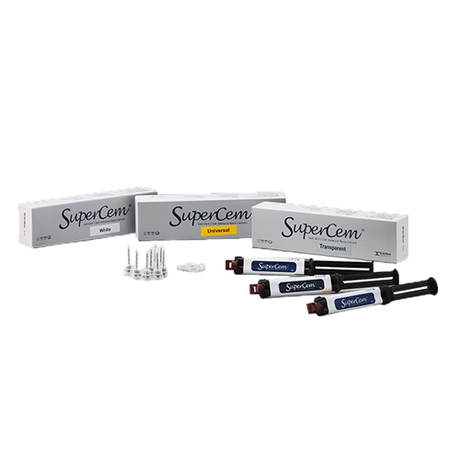
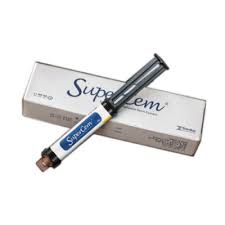
Charm SuperCem dual cured dental resin cement 9 g
Very low stock (6 units)Regular price LE 1,175.00 EGPUnit price /Unavailable-

HANDAE
Han Luting Dual cured dental resin cement 9 g
Very low stock (7 units)Regular price LE 999.00 EGPUnit price /UnavailableGC
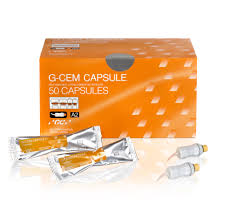
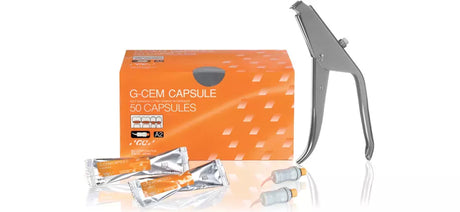
G-CEM Self-Adhesive Resin Luting Cement Capsules 0.17 mL
Low stock (18 units)Regular price LE 250.00 EGPUnit price /Unavailable-

incidental
RubySE Self-etching Self-adhesive Resin Cement
Very low stock (2 units)Regular price LE 649.00 EGPUnit price /Unavailable
Ivoclar vivadent
Ivoclar Variolink Esthetic DC neutral Dual-curing resin cement Refill 1x5g
Very low stock (6 units)Regular price LE 8,400.00 EGPUnit price /Unavailable
Jen-D
Jen-D JEN– Duacem FR Dual Cure Resin Cement 8.4 g
Low stock (19 units)Regular price LE 1,425.00 EGPUnit price /Unavailable
Ivoclar vivadent
Ivoclar Variolink Esthetic LC 2 g refill syringes
Very low stock (6 units)Regular price LE 3,700.00 EGPUnit price /Unavailable 11% off
Kettenbach
Kettenbach Visalys Core Dentin Syringe 1 piece
Low stock (20 units)Sale price LE 1,950.00 EGP Regular price LE 2,200.00Unit price /Unavailable 18% off
Kettenbach
Kettenbach Visalys CemCore Starter Set
Low stock (20 units)Sale price LE 4,100.00 EGP Regular price LE 5,000.00Unit price /Unavailable 18% off
Kettenbach
Kettenbach Visalys CemCore Refill Translucent
Low stock (20 units)Sale price LE 4,100.00 EGP Regular price LE 5,000.00Unit price /Unavailable
Ivoclar vivadent
Ivoclar Variolink N Catalyst Transparent Cement
Low stock (20 units)Regular price LE 1,995.00 EGPUnit price /Unavailable
Ivoclar vivadent
Ivoclar Variolink N Base Cement
In stock (40 units)Regular price From LE 1,995.00 EGPUnit price /Unavailable
OT Dent
OT Dual Cure Resin Cement 8.5 gm
Low stock (20 units)Regular price LE 1,425.00 EGPUnit price /UnavailableMasterdent
Masterdent DC Resin Cement 10g
Low stock (20 units)Regular price LE 1,515.00 EGPUnit price /Unavailable-

Kerr
Kerr Maxcem Elite Chroma Self-Etch, Self-Adhesive Resin Dental Cement Refill 1 Syringe
Low stock (20 units)Regular price LE 2,640.00 EGPUnit price /Unavailable
Kerr
Kerr Maxcem Elite Refill Self-Etch, Self-Adhesive Dental Cement 1 syringe
Low stock (15 units)Regular price LE 2,325.00 EGPUnit price /Unavailable



How to Choose the Right Dental Resin Cement for Your Practice
- Dual-Cure vs Light-Cure vs Self-Adhesive — Dual-cure resin cements (e.g., Charm SuperCem, NOVA Dual Cure, Han Luting) polymerize both chemically and by light activation, making them suitable for thick restorations or areas where the curing light cannot penetrate adequately (e.g., fiber posts cemented deep in the canal). Light-cure only cements are restricted to translucent restorations less than 2 mm thick. Self-adhesive resin cements (e.g., OverCEM SA) require no separate etching or bonding step — they bond directly to enamel, dentine, and restoration surface — reducing protocol complexity and sensitivity in Egyptian clinical settings.
- MDP Monomer and Chemical Adhesion — Resin cements containing MDP (10-methacryloyloxydecyl dihydrogen phosphate) monomer form a chemical bond to zirconia, alumina, and metal alloy surfaces via ionic exchange, supplementing the micromechanical retention from sandblasting. For zirconia crowns cemented without primer, specify a resin cement with MDP monomer or use a dedicated zirconia primer (e.g., Z-Prime Plus) alongside a non-MDP cement. Without MDP or primer, adhesion relies solely on sandblasting — insufficient for adhesive veneer cementation scenarios where isolation is imperfect.
- Film Thickness and Marginal Gap — ISO 9917-2 requires a film thickness of less than 50 µm for luting cements. Most dental resin cements comply with 20–35 µm film thickness. Excess film thickness creates a perceptible gap at the restoration margin that accumulates plaque and secondary caries — relevant when cementing ceramic inlays and onlays in Egyptian patients with high caries risk. Check manufacturer-specified film thickness before selecting a cement for thin ceramic veneers where marginal discrepancy is clinically visible.
- Shade and Opacity Options — Resin cements for anterior ceramic veneers and all-ceramic crowns are supplied in multiple shades (A1, A2, BW, translucent) to allow shade modification after cementation. For posterior restorations and fiber posts, opacity and shade are clinically less critical. Request the shade selector or try-in paste equivalent if the cement is to be used for anterior veneers — particularly important for Egyptian patients who may request specific VITA shade matching.
- Bonding Protocol Requirement: Self-Adhesive vs Conventional — Conventional dual-cure resin cements (requiring etching and bonding) achieve higher bond strengths to dentine (18–25 MPa, ISO 29022) than self-adhesive types (8–15 MPa) but involve more protocol steps and greater technique sensitivity. In Egyptian clinics with challenging moisture control, self-adhesive cements reduce the risk of bond failure due to contamination. For adhesive ceramic veneers requiring maximum dentine bond strength, conventional protocol with phosphoric acid etch + bonding agent is preferred.
- Capsule vs Syringe vs Paste-Paste Dispensing — Automix syringe systems (e.g., OverCEM SA, Charm SuperCem 9g cartridges) deliver a consistent base-to-catalyst ratio with minimal air incorporation. SDI SeT capsules are pre-metered for single-use application on one abutment. Paste-paste manually mixed variants allow larger volume for multi-unit bridge cementation but risk incorrect mixing ratios if proportioning is estimated rather than weighed. For Egyptian clinics cementing single-unit restorations, automix or capsule formats minimize waste and ensure consistent mix quality.
Resin Cement Types at a Glance
| Cement | Cure Mode | Self-Adhesive? | MDP Monomer | Best Indication |
|---|---|---|---|---|
| Charm SuperCem | Dual-cure | No (requires bonding) | Check TDS | All-ceramic crowns, fiber posts |
| NOVA Dual Cure | Dual-cure | No (requires bonding) | Check TDS | Crowns, inlays, onlays |
| OverCEM SA | Dual-cure | Yes | Yes | Crowns, bridges (simplified protocol) |
| SDI SeT Capsules | Dual-cure | No (requires bonding) | Check TDS | Single-unit restoration cementation |
| Han Luting | Dual-cure | No (requires bonding) | Check TDS | All-ceramic crowns, fiber posts |
Availability & Delivery in Egypt
Dental resin cements on MedSTA are priced in EGP with nationwide delivery across Egypt. Store cement cartridges and pastes in a cool, dry environment (below 25°C) away from direct light exposure to prevent premature chemical initiation of the dual-cure component. Orders within Cairo and Giza are typically fulfilled within 1–2 business days; delivery to other Egyptian governorates takes 2–4 business days.
Frequently Asked Questions — Dental Resin Cements
When should I use a self-adhesive resin cement instead of a conventional dual-cure resin cement?
When should I use a self-adhesive resin cement instead of a conventional dual-cure resin cement?
Self-adhesive cements (e.g., OverCEM SA) bond without a separate etching or bonding step, reducing moisture sensitivity — preferred for crowns and bridges in Egyptian clinics where rubber dam isolation is not always feasible. Conventional dual-cure cements achieve higher dentine bond strengths (18–25 MPa vs 8–15 MPa for self-adhesive) and are preferred for adhesive ceramic veneers, CAD/CAM ceramic inlays, and fiber post cementation.
Does dental resin cement with MDP monomer bond to zirconia without a separate primer?
Does dental resin cement with MDP monomer bond to zirconia without a separate primer?
Resin cements containing MDP monomer form an ionic bond to zirconia surface oxides. In practice, a dedicated zirconia primer (e.g., Z-Prime Plus) applied before cementation consistently achieves higher bond strengths than relying on cement MDP content alone. The evidence-based protocol for zirconia: sandblast with 50 µm alumina, prime, then cement with dual-cure resin cement.
What is the film thickness of dental resin cements and why does it matter?
What is the film thickness of dental resin cements and why does it matter?
ISO 9917-2 requires a film thickness below 50 µm for luting cements. Most dual-cure resin cements achieve 20–35 µm. Excess film thickness creates a marginal gap that accumulates plaque and secondary caries — particularly relevant for ceramic inlays and onlays in Egyptian patients with active caries risk. Confirm manufacturer-specified film thickness before selecting a cement for thin ceramic veneers where marginal discrepancy is clinically visible.
Can dual-cure resin cement be used for cementing fiber posts deep inside root canals?
Can dual-cure resin cement be used for cementing fiber posts deep inside root canals?
Yes. Dual-cure resin cements are the material of choice for fiber post cementation because light cannot reach the full post length inside the canal. The chemical-cure component ensures complete polymerization throughout the post length. Deliver cement using a spiral-tip or lentulo spiral directly into the canal before inserting the post to minimize void formation at the canal walls.
How should dental resin cement cartridges be stored in Egyptian clinics during summer?
How should dental resin cement cartridges be stored in Egyptian clinics during summer?
Store resin cement cartridges and syringes below 25°C, away from direct sunlight. Egyptian summer temperatures above 35°C can accelerate chemical curing inside the cartridge, shortening effective shelf life. Refrigeration at 4–8°C is acceptable for long-term storage; allow the cartridge to reach room temperature before use to prevent condensation and viscosity changes that affect the automix ratio.