

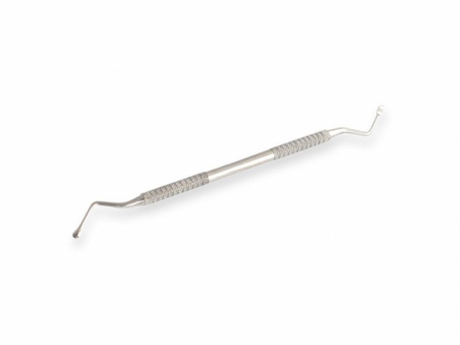
GENERIC
Low stock (10 units)Regular price LE 70.00 EGPUnit price /Unavailable
Choosing the Right Bone Curette for Your Practice
- Tip Shape: Curved vs Straight — Curved tips navigate anatomical contours more easily. Straight curettes provide direct access for flat surfaces, while curved designs suit extraction sockets and irregular bone defects.
- Working End Size — Select spoon width based on surgical site dimensions. Smaller working ends offer precision in tight areas; larger ends increase efficiency for broader bone surfaces and grafting procedures.
- Handle Ergonomics — Comfortable handles reduce hand fatigue during surgery. Textured or knurled handles improve grip control, especially important during procedures requiring sustained pressure application.
- Material and Sterilisation — Stainless steel construction ensures autoclave compatibility. Quality surgical-grade steel maintains sharp edges through repeated sterilisation cycles without corrosion or edge degradation.
- Bone Scrapers for Harvesting — Dedicated scrapers collect autogenous bone efficiently. Bone scrapers with collection chambers or curved designs help harvest particulate bone for grafting during implant site preparation.
- Single vs Double-Ended Instruments — Double-ended curettes offer two tip sizes in one tool. This design reduces instrument changes during procedures, though single-ended options may provide better balance for some clinicians.
Bone Curette Types at a Glance
| Curette Type | Best Application | Tip Design | Key Feature |
|---|---|---|---|
| Standard Bone Curette | Socket debridement | Rounded spoon | General-purpose use |
| Curved Bone Curette | Irregular defects | Angled working end | Access to contoured areas |
| Bone Scraper | Bone harvesting | Flat or curved blade | Autogenous graft collection |
| Surgical Curette | Soft tissue removal | Sharp edges | Granulation tissue debridement |
| Double-Ended Curette | Multiple site sizes | Two tip options | Reduced instrument changes |
How to Select Bone Curettes for Your Clinic
- Identify your primary procedures: extractions, implants, periodontal surgery, or bone grafting.
- Choose tip shapes matching your most common surgical site anatomies and access requirements.
- Verify stainless steel grade for autoclave durability and edge retention over time.
- Consider handle design for comfort during longer surgical procedures.
- Stock both curved and straight options to cover varied clinical situations.
Availability & Delivery in Egypt
All bone curettes at MedSTA are priced in EGP with nationwide delivery across Egypt. Store instruments in dry, climate-controlled conditions to prevent corrosion before sterilisation.
Frequently Asked Questions
What is a bone curette used for in dentistry?
What is a bone curette used for in dentistry?
Bone curettes debride extraction sockets, remove granulation tissue, and prepare bone surfaces for grafting.
What is the difference between a bone curette and bone scraper?
What is the difference between a bone curette and bone scraper?
Curettes remove tissue and debris; scrapers harvest autogenous bone particles for grafting procedures.
Can bone curettes be autoclaved?
Can bone curettes be autoclaved?
Yes, stainless steel bone curettes are designed for repeated autoclave sterilisation cycles.
When should I use a curved bone curette?
When should I use a curved bone curette?
Use curved curettes for accessing irregular bone defects and navigating extraction socket walls.
How do I maintain sharp edges on bone curettes?
How do I maintain sharp edges on bone curettes?
Follow manufacturer sharpening guidelines and avoid contact with hard surfaces during storage.
Are bone curettes suitable for implant surgery?
Are bone curettes suitable for implant surgery?
Yes, they prepare implant sites by removing soft tissue and smoothing bone surfaces.
Does MedSTA deliver bone curettes throughout Egypt?
Does MedSTA deliver bone curettes throughout Egypt?
Yes, MedSTA offers nationwide delivery across Egypt with EGP pricing on all instruments.