
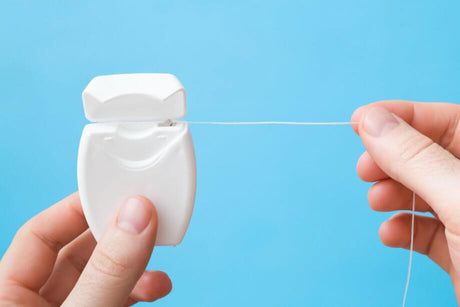
Dental Floss: Clinical and Patient Use Guide
- Waxed vs Unwaxed Floss — Waxed floss passes more easily through tight interproximal contacts without shredding — preferred for Egyptian patients with crowded anterior teeth or tight restorative contacts. Unwaxed floss produces a squeaking sound when clean enamel surface is reached (cleaning endpoint cue) and has a slightly larger effective surface area per pass for plaque disruption — but shreds in tight contacts or on rough restoration margins.
- Floss Thickness (Standard vs Tape vs Super Floss) — Standard floss for normal contacts; dental tape (wider, flat cross-section) for wide embrasures and around implant superstructures where more surface coverage per pass is clinically useful; Super Floss (Oral-B) has a stiffened end (threader), a spongy segment (cleans under bridges and implant bars), and regular floss — ideal for Egyptian patients with fixed prosthodontic restorations.
- PTFE Floss (Glide-type) — Monofilament PTFE (polytetrafluoroethylene) floss is virtually shred-proof, glides through very tight contacts with minimal force, and is recommended for patients with tight contacts, veneers, or ceramic restorations where conventional floss shredding leaves fibre debris on the restoration surface.
- Clinical Use (Rubber Dam Ligature) — In endodontic practice, dental floss is used to floss under the rubber dam clamp wing to secure the rubber dam sheet in tight contact with the tooth, preventing saliva ingress into the isolated field. This clinical application is distinct from patient home use and requires standard or tape floss rather than PTFE, which is too slippery for secure ligature knot tying.
- Flavour and Patient Compliance — Flavoured floss (mint) improves patient compliance with home interdental cleaning routines in Egyptian dental practices focused on preventive dentistry — particularly relevant for paediatric and young adult patients where compliance with daily flossing is a known challenge.
Availability & Delivery in Egypt
MedSTA supplies dental floss in EGP with same-day dispatch from Cairo. Cairo and Giza delivery within 1–3 business days; all other Egyptian governorates within 3–5 business days. Suitable for patient take-home supply and clinical endodontic use.
Frequently Asked Questions
What is the best type of dental floss for patients with very tight interproximal contacts?
What is the best type of dental floss for patients with very tight interproximal contacts?
PTFE (Glide-type) monofilament floss is the best choice for patients with very tight contacts; its smooth surface and high tensile strength allow it to slip through narrow embrasures without shredding or snapping. For Egyptian patients with crowded mandibular anterior teeth or tight Class II composite contacts, PTFE floss reduces gingival trauma from repeated snapping floss through tight contacts. Waxed floss is the second choice; unwaxed multifilament floss should be avoided in tight contacts where shredding is a persistent problem.
How is dental floss used clinically in endodontic rubber dam placement?
How is dental floss used clinically in endodontic rubber dam placement?
In endodontic practice, a length of dental floss (approximately 25–30 cm) is tied in a loop and slipped under the wings of the rubber dam clamp before isolation, then passed beneath the rubber dam sheet. After the dam is placed, the floss loop is cinched tight against the cervical tooth structure, creating a ligature that holds the rubber dam against the tooth neck in the sulcus, preventing saliva contamination of the isolated field. Standard or tape floss is used — PTFE floss is too slippery for the cinch knot to hold reliably.
How often should Egyptian dental patients floss?
How often should Egyptian dental patients floss?
The ADA and Egyptian dental prevention guidelines recommend once-daily interdental cleaning with floss, interdental brushes, or a water flosser before or after toothbrushing. The clinical evidence for flossing frequency is strongest for once daily; twice-daily flossing offers marginal additional benefit for plaque removal. Encourage evening flossing before the last tooth brushing of the day so that interproximal surfaces are cleaned before the overnight low-salivary-flow period that favours cariogenic bacterial metabolism.
Can dental floss damage dental implants or ceramic veneers?
Can dental floss damage dental implants or ceramic veneers?
Conventional multifilament floss used with light force does not damage ceramic veneer surfaces or implant abutment materials. However, floss fibres that shred and leave fragments under ceramic veneer margins or around implant abutments cause gingival inflammation if not fully removed. For implants and veneers, use PTFE or Super Floss; for cemented implant crowns, avoid snap-through flossing that displaces provisional cement at the crown margin. Water flossers are a useful adjunct to floss for interdental cleaning around implant superstructures in Egyptian patients with limited manual dexterity.
Does MedSTA supply dental floss for clinical and patient use across Egypt?
Does MedSTA supply dental floss for clinical and patient use across Egypt?
Yes — MedSTA supplies standard dental floss in EGP with same-day dispatch from Cairo. Cairo and Giza delivery within 1–3 business days; all other Egyptian governorates within 3–5 business days. Suitable for chairside use (rubber dam ligature, retraction cord assistance) and patient take-home prescription in Egyptian dental practices.