

GENERIC
Very low stock (7 units)Regular price LE 29.00 EGPUnit price /Unavailable-


Sedra dent
Sedra Nabers periodontal probe
Very low stock (6 units)Regular price LE 410.00 EGPUnit price /Unavailable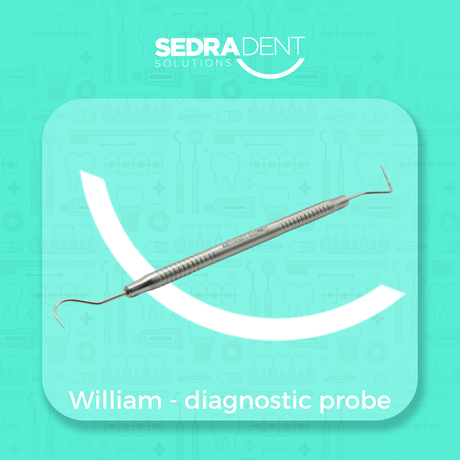
Sedra dent
Sedradent william periodontal probe
Very low stock (4 units)Regular price LE 325.00 EGPUnit price /Unavailable
NOVA
Very low stock (4 units)Regular price LE 400.00 EGPUnit price /Unavailable


How to Choose the Right Periodontal Probe for Your Practice
- Williams Markings vs UNC-15 Markings — Williams probes mark at 1, 2, 3, 5, 7, 8, 9, and 10mm (skipping 4 and 6 to prevent misreading), while UNC-15 probes mark every millimetre from 1-15mm with colour-coded bands at 5, 10, and 15mm — UNC-15 gives finer resolution for research-grade charting, while Williams markings are faster to read chairside for routine periodontal screening.
- Nabers Furcation Probe Curvature — Nabers probes have a blunt, curved tip specifically shaped to enter furcation entrances horizontally without perforating the interradicular bone — a straight graduated probe cannot safely assess furcation involvement using this technique.
- Probe Tip Diameter and Probing Force — Standard probe tips measure approximately 0.4-0.5mm in diameter; a thinner tip improves tactile sensitivity for detecting subgingival calculus and the base of the pocket, but every probe requires consistent light probing force (approximately 20-25 grams) to avoid false pocket-depth readings from tissue compression.
- Pressure-Sensitive vs Manual Probes — Manual probes rely on operator-controlled force and are standard for routine Egyptian clinical practice; pressure-sensitive (constant-force) probes standardise the 20-25g insertion force electronically, reducing inter-examiner variability, and are more common in periodontal specialist and research settings.
- Single-Ended vs Double-Ended Design — Double-ended probes often pair a graduated probe with a Nabers furcation probe or an explorer on the opposite end, reducing instrument changes during a combined periodontal charting and furcation assessment.
Periodontal Probe Types at a Glance
| Type | Markings | Primary Use |
|---|---|---|
| Williams probe | 1,2,3,5,7,8,9,10mm | Routine pocket depth charting |
| UNC-15 probe | Every 1mm to 15mm, colour bands | Research-grade, precise charting |
| Nabers probe | Curved, blunt tip | Furcation involvement assessment |
| Generic graduated probe | Basic mm markings | General screening, student use |
Availability & Delivery in Egypt
MedSTA stocks Williams, UNC-15, and Nabers furcation probes from Sedra dent and Bibodent, priced from approximately 29 EGP for basic student-grade probes up to 410 EGP for calibrated clinical designs, with fast delivery to dental clinics and periodontal practices across Cairo, Giza, Alexandria, and all Egyptian governorates.
Frequently Asked Questions
What is the difference between Williams and UNC-15 probe markings?
What is the difference between Williams and UNC-15 probe markings?
Williams probes mark at 1, 2, 3, 5, 7, 8, 9, and 10mm — deliberately skipping 4 and 6mm to prevent misreading similar-looking bands under chairside lighting. UNC-15 probes mark every single millimetre up to 15mm with colour-coded bands at 5, 10, and 15mm, giving finer measurement resolution for research documentation or deep pocket cases beyond 10mm. Most routine Egyptian periodontal screening uses Williams markings for charting speed.
How is a Nabers probe used to assess furcation involvement?
How is a Nabers probe used to assess furcation involvement?
The curved, blunt Nabers tip is inserted horizontally into the furcation entrance from the buccal or lingual aspect, following the roof or floor of the furcation to determine how far the probe travels before meeting resistance — classified as Class I (incipient, less than 3mm horizontal penetration), Class II (moderate, more than 3mm without through-and-through access), or Class III (through-and-through). A straight graduated probe cannot safely follow this curved anatomy.
How much probing force should be applied during periodontal charting?
How much probing force should be applied during periodontal charting?
Approximately 20-25 grams — roughly the force needed to blanch the tip of a fingernail when pressed against the pad of a finger. Excessive force compresses inflamed connective tissue and produces a falsely deep pocket-depth reading, while insufficient force fails to reach the true base of the pocket. Pressure-sensitive probes standardise this force electronically; manual probes rely on calibrated operator technique.
Can the same periodontal probe be used for BPE/PSR screening and full-mouth charting?
Can the same periodontal probe be used for BPE/PSR screening and full-mouth charting?
Yes, though a WHO/BPE probe with a 0.5mm ball tip and a single 3.5mm and 5.5mm colour-coded band is purpose-built for rapid six-sextant BPE screening, while a Williams or UNC-15 probe is better suited to full six-point-per-tooth periodontal charting once a sextant screens positive. Many Egyptian general practices keep both probe types on the diagnostic tray.
Does MedSTA supply periodontal probes across Egypt?
Does MedSTA supply periodontal probes across Egypt?
Yes. MedSTA supplies Williams, UNC-15, and Nabers furcation probes from Sedra dent and Bibodent, with EGP pricing and fast delivery to dental clinics, periodontal practices, and dental schools throughout Egypt.