
GENERIC
Low stock (13 units)Regular price From LE 50.00 EGPUnit price /Unavailable-

GENERIC
In stock (35 units)Regular price From LE 130.00 EGPUnit price /Unavailable

Ultradent
Very low stock (2 units)Regular price LE 280.00 EGPUnit price /Unavailable
Ultradent
Very low stock (3 units)Regular price LE 115.00 EGPUnit price /Unavailable
Kerr
Kerr OptiShine first concave-shaped polishing brush
Low stock (10 units)Regular price From LE 383.00 EGPUnit price /Unavailable
Cotisen
Cotisen- Soft Prophy Tapered Assorted Brushes
Very low stock (5 units)Regular price LE 350.00 EGPUnit price /Unavailable
Cotisen
Cotisen Soft Prophy Cups Tapered
Very low stock (5 units)Regular price LE 350.00 EGPUnit price /Unavailable


How to Choose the Right Dental Polishing Brushes for Your Practice
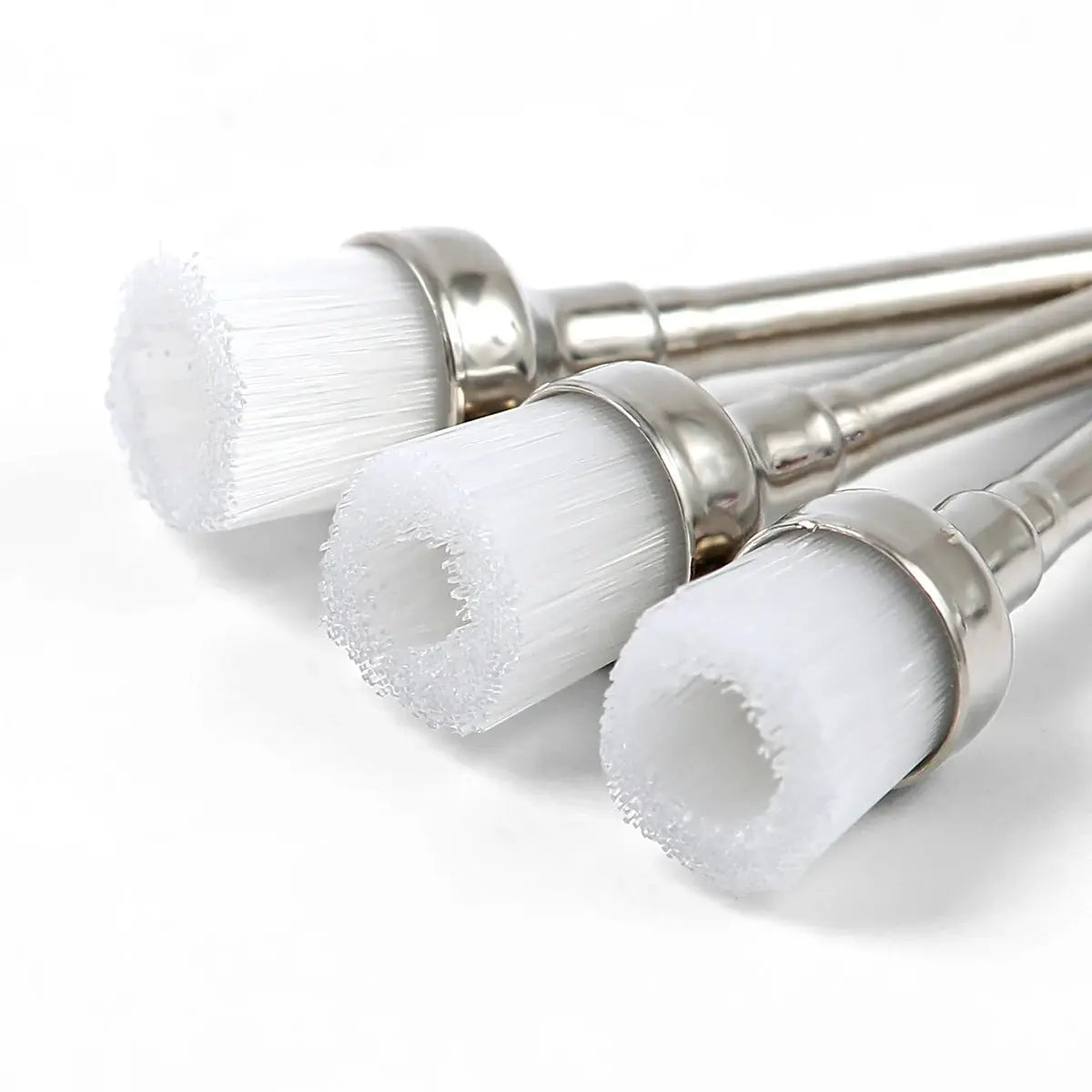
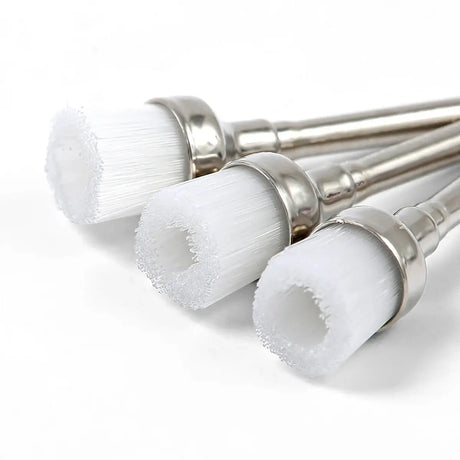
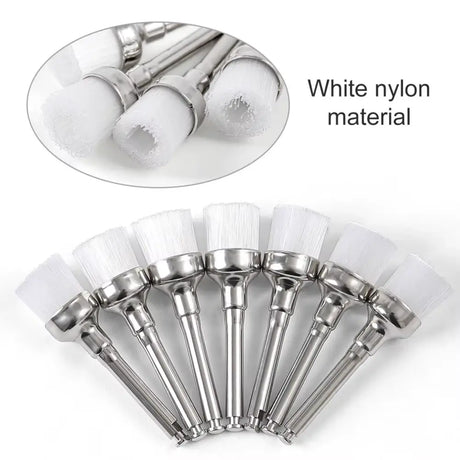
- Bristle Brush vs Rubber Cup — Bristle brushes (prophy brushes) are used for occlusal surface stain removal, reaching into pits and fissures that a rubber cup cannot access. Rubber cups (prophy cups) are used for smooth facial, lingual, and proximal surfaces. Most prophylaxis sequences use both in combination: bristle brush first for occlusal surfaces, rubber cup for smooth surfaces. For whitening prophylaxis specifically, rubber cups with fine-grit paste are preferred to avoid enamel abrasion.
- Bristle Stiffness (Soft vs Pointed) — Flat soft bristle brushes are standard for routine prophylaxis on healthy enamel. Pointed/tapered bristle configurations improve interproximal and subgingival margin access in patients with crowded dentition or fixed restorations. Choose tapered bristles for patients with orthodontic brackets or subgingival stain accumulation that flat brushes cannot reach.
- Web-Grip vs Snap-On Attachment — Prophy brushes and cups attach via a web-grip (friction-fit over the prophylaxis angle nose) or a snap-on latch design. Confirm your contra-angle prophylaxis attachment style before ordering — the two are not interchangeable. Web-grip is the Egyptian market standard for most low-speed angle systems.
- Single-Use vs Autoclavable — Disposable single-use prophy cups (most common, 50–100 pcs per pack) are recommended for infection control compliance. Autoclavable brushes (silicone or nylon) withstand 134°C steam sterilization but must be inspected for bristle loss and deformation after each cycle, as degraded bristles can scratch enamel at prophy-paste grit sizes above 40 µm.
- Compatibility with Prophy Paste Grit — For routine maintenance prophylaxis, pair medium-grit paste (particle size 25–40 µm) with a standard prophy brush or rubber cup. For heavy stain removal (tea, coffee, tobacco in Egyptian patients), coarse-grit paste (>40 µm) is effective but should be followed by fine-grit polishing to avoid leaving a rough enamel surface that accelerates future staining.
Prophy Brush Type Guide
| Type | Best Surface | Stiffness | Use Case |
|---|---|---|---|
| Flat bristle brush | Occlusal, pits & fissures | Soft | Routine prophylaxis |
| Pointed/tapered bristle | Interproximal, subgingival margins | Medium | Crowded teeth, fixed appliances |
| Rubber cup | Smooth facial, lingual, proximal | Flexible | Polish and stain removal |
Availability & Delivery in Egypt
MedSTA stocks prophy brushes from trusted brands including Ultradent Opal Cup and generic disposable options, priced from 50–210 EGP per pack, delivered to general and periodontic practices across Cairo, Giza, Alexandria, and all Egyptian governorates. Disposable 100-piece packs are available for high-volume practices.
Frequently Asked Questions
What is the difference between a prophy brush and a rubber cup for dental polishing?
What is the difference between a prophy brush and a rubber cup for dental polishing?
Prophy (prophylaxis) brushes are used for occlusal surface stain removal, reaching pits and fissures that a rubber cup cannot access. Rubber cups are used for smooth facial, lingual, and proximal surfaces. Most prophylaxis sequences use both: bristle brush first on occlusal surfaces, then rubber cup for smooth surfaces. For whitening prophylaxis, rubber cups with fine-grit paste are preferred to minimise enamel abrasion.
Can prophy brushes be autoclaved and reused between patients?
Can prophy brushes be autoclaved and reused between patients?
Autoclavable silicone or nylon prophy brushes withstand 134°C steam sterilization but must be inspected after each cycle for bristle loss, deformation, or contamination. Disposable single-use cups (50–100 per pack) are strongly recommended for infection control compliance in Egyptian dental practices, as they eliminate the risk of inadequate sterilization between patients.
What grit of prophy paste should I use with a polishing brush?
What grit of prophy paste should I use with a polishing brush?
For routine maintenance prophylaxis, pair medium-grit paste (particle size 25–40 µm) with a standard prophy brush. For heavy stain removal common in Egyptian patients who consume tea, coffee, or tobacco, coarse-grit paste (>40 µm) removes stain effectively but should be followed by fine-grit paste to smooth the enamel surface. Never use coarse-grit paste adjacent to composite restorations.
How do I prevent prophy brush abrasion on composite restorations?
How do I prevent prophy brush abrasion on composite restorations?
Avoid using prophy brushes or coarse-grit prophy paste directly on composite surfaces. Composites are softer than enamel and scratch easily with abrasive prophylaxis materials. Use a rubber cup with fine-grit or polishing-only paste (no abrasive) when cleaning around composite restorations. For complete composite polishing, use composite polishing points or discs, not prophy brushes.
Does MedSTA supply dental polishing brushes across Egypt?
Does MedSTA supply dental polishing brushes across Egypt?
Yes. MedSTA delivers prophy brushes from Ultradent and other trusted brands to general and periodontic practices across Cairo, Giza, Alexandria, and all Egyptian governorates, priced in EGP with fast nationwide delivery.