

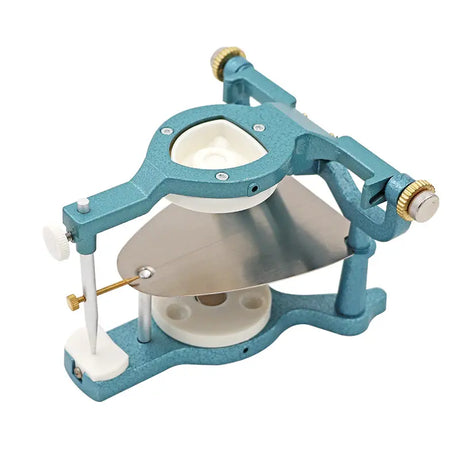
GENERIC
Very low stock (5 units)Regular price LE 480.00 EGPUnit price /Unavailable


Essential Guide to Articulators & Facebows for Your Practice
- Articulator Types and Clinical Uses — Choose between simple hinge, semi-adjustable, or fully adjustable models. Simple articulators suit basic prosthetic work, while semi-adjustable types offer condylar angle settings for more precise occlusal schemes.
- Facebow Function and Transfer Accuracy — Facebows record the spatial relationship of the maxilla to the skull. This transfer ensures your mounted casts replicate the patient's actual hinge axis, improving restoration fit and occlusal accuracy.
- Semi-Adjustable vs Fully Adjustable Systems — Semi-adjustable articulators balance cost and clinical precision effectively. Fully adjustable systems offer superior customisation for complex rehabilitations but require more training and setup time.
- Materials and Build Quality — Durable metal construction ensures long-term stability and accuracy. Look for precision-machined components and secure locking mechanisms that maintain consistent settings between appointments.
- Compatibility with Mounting Plates — Verify compatibility between your articulator and mounting plate system. Standardised mounting systems allow easy case transfer between clinic and laboratory without remounting.
- Maintenance and Calibration Requirements — Regular cleaning and calibration preserve instrument accuracy. Inspect hinge pins, condylar elements, and incisal pins periodically to ensure consistent performance across clinical cases.
Articulator & Facebow Types at a Glance
| Product Type | Primary Application | Adjustability Level | Best Suited For |
|---|---|---|---|
| Simple Hinge Articulator | Basic denture work | Non-adjustable | Student training, simple cases |
| Semi-Adjustable Articulator | Crown, bridge, prosthetics | Moderate | General practice, most restorations |
| Fully Adjustable Articulator | Complex rehabilitations | High | Specialist prosthodontic cases |
| Earbow Facebow | Arbitrary axis transfer | N/A | Routine prosthetic mounting |
| Kinematic Facebow | True hinge axis location | N/A | Complex occlusal analysis |
How to Select the Right Articulator & Facebow
- Assess your typical case complexity to determine required adjustability level.
- Consider lab compatibility if you outsource prosthetic fabrication.
- Verify facebow system matches your chosen articulator brand and model.
- Check for replacement part availability for long-term instrument maintenance.
- Factor in training requirements for semi-adjustable or fully adjustable systems.
Availability & Delivery in Egypt
All articulators and facebows at MedSTA are priced in EGP with nationwide delivery across Egypt. Store instruments in a clean, dry environment to maintain precision and extend service life.
Frequently Asked Questions
What is the difference between an articulator and a facebow?
What is the difference between an articulator and a facebow?
An articulator simulates jaw movement; a facebow transfers the maxillary position to mount casts accurately.
Do I need a facebow for every prosthetic case?
Do I need a facebow for every prosthetic case?
Facebow use improves accuracy, especially for fixed prosthetics and complex occlusal rehabilitations.
Can I use any facebow with any articulator?
Can I use any facebow with any articulator?
No, facebows are typically designed for specific articulator systems. Verify compatibility before purchasing.
How often should I calibrate my articulator?
How often should I calibrate my articulator?
Check calibration monthly or whenever you notice inconsistencies in mounted case occlusion.
Are semi-adjustable articulators sufficient for crown and bridge work?
Are semi-adjustable articulators sufficient for crown and bridge work?
Yes, semi-adjustable articulators provide adequate precision for most routine restorative cases.
What is an arbitrary facebow transfer?
What is an arbitrary facebow transfer?
It uses anatomical landmarks rather than locating the true hinge axis, suitable for most clinical cases.
How do I clean and maintain my articulator?
How do I clean and maintain my articulator?
Wipe with a dry cloth after use, lubricate moving parts periodically, and store in a protective case.