
GENERIC
In stock (48 units)Regular price LE 41.00 EGPUnit price /Unavailable
Tongue Depressors: Selection and Clinical Use
- Size (Standard vs Junior vs Paediatric) — Standard adult tongue depressors (152 mm × 18 mm) are appropriate for adult oral and pharyngeal examination. Junior size (140 mm × 15 mm) provides better access in patients with limited mouth opening; paediatric/infant size (120 mm × 10 mm) is required for children under 5 where a full-size depressor triggers gag reflex more readily due to relative oral cavity dimensions.
- Wood Type (Birch vs Pine) — Birch wood tongue depressors are denser, smoother-surfaced, and do not splinter under normal clinical force, making them the appropriate choice for oral examination. Pine sticks are more economical but have rougher grain that causes mucosal irritation and occasional splinter risk if excessive force is used during tongue retraction.
- Sterile vs Non-Sterile Packing — Non-sterile wooden tongue depressors in bulk boxes are adequate for standard oral examination in Egyptian dental and medical outpatient settings where intact oral mucosa is examined. Individually sterile-wrapped depressors are required when the stick contacts an open wound or mucosal defect where infection risk from surface biofilm is clinically significant.
- Clinical Dental Applications — In dental practice, tongue depressors serve additional roles: mixing zinc oxide eugenol (ZOE) and alginate impression material on a paper mixing pad; applying topical anesthetic gel to mucosa; checking occlusion by marking with bite registration; retraction of the tongue for lingual surface inspection; and as a handle for gauze sponge placement in the posterior mouth during extraction.
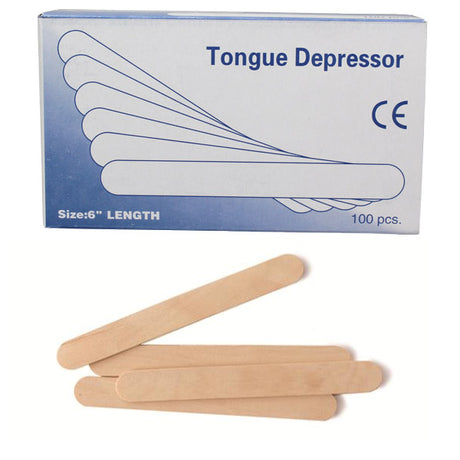
- Pack Size (100 pcs per box) — A 100-piece box at 35 EGP provides approximately 2–5 working days supply for a single-chair Egyptian dental clinic using 20–50 depressors per day across examination and material mixing applications.
Availability & Delivery in Egypt
MedSTA supplies wooden tongue depressors in EGP with same-day dispatch from Cairo. Cairo and Giza delivery within 1–3 business days; all other Egyptian governorates within 3–5 business days. Suitable for Egyptian dental clinics, medical practices, and hospitals.
Frequently Asked Questions
What material are dental tongue depressors made from?
What material are dental tongue depressors made from?
Dental and medical tongue depressors are made from birch wood (preferred) or pine, shaped by precision milling to a smooth, flat stick with slightly rounded ends and edges to prevent mucosal abrasion during examination. Birch is preferred for its fine, smooth grain that minimises splinter risk and surface roughness during tongue retraction. Plastic tongue depressors (polypropylene or acrylic) are also available and autoclavable for settings where sterile reusable instruments are required, but wooden single-use sticks are standard in Egyptian dental outpatient settings for their low cost and ready availability.
Can wooden tongue depressors be used to mix dental impression materials?
Can wooden tongue depressors be used to mix dental impression materials?
Yes — wooden tongue depressors are commonly used in Egyptian dental practices to spatulate small amounts of alginate (for individual tooth impressions), ZOE impression paste, and temporary cement on paper mixing pads. However, for full-arch alginate impressions requiring vigorous spatulation for 1–2 minutes, a dedicated cement/alginate spatula with a longer, wider blade is more efficient and produces a more homogeneous mix. Use tongue depressors for small-volume mixing applications where their blade size is adequate for the required mix volume.
Are tongue depressors sterile from the box?
Are tongue depressors sterile from the box?
Standard boxed wooden tongue depressors (100 pcs per box) are NOT sterile — they are manufactured and packaged under clean (not sterile) conditions. They are appropriate for contact with intact oral mucosa during examination, which is a non-sterile tissue surface in the normal dental visit. For procedures involving open wounds (post-extraction examination, pericoronitis assessment) or application of topical steroids/antifungals to ulcerated mucosa, use individually gamma-sterilised tongue depressors that confirm sterility by packaging indicators.
How should tongue depressors be disposed of after clinical use?
How should tongue depressors be disposed of after clinical use?
Wooden tongue depressors contaminated with blood, saliva, or pathological secretions are classified as clinical waste and must be disposed of in yellow clinical waste bags (Category B or equivalent per Egyptian medical waste regulations), not in general office waste. Non-contaminated depressors used only for dry material mixing can be disposed of in general waste. Never reuse a tongue depressor between patients or between oral sites on the same patient as this constitutes cross-contamination under Egyptian Ministry of Health dental infection control guidelines.
Does MedSTA supply wooden tongue depressors in bulk across Egypt?
Does MedSTA supply wooden tongue depressors in bulk across Egypt?
Yes — MedSTA supplies wooden tongue depressors in 100-piece packs in EGP with same-day dispatch from Cairo. Cairo and Giza delivery within 1–3 business days; all other Egyptian governorates within 3–5 business days. Bulk packs are available for Egyptian hospitals, medical centres, and dental faculty clinics.