

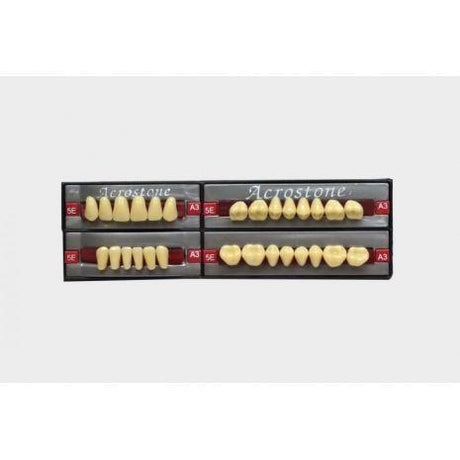
Acrostone
In stock (22 units)Regular price LE 79.00 EGPUnit price /Unavailable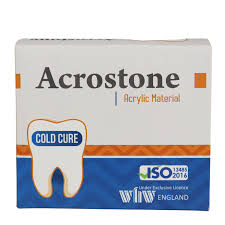
Acrostone
Low stock (10 units)Regular price LE 385.00 EGPUnit price /Unavailable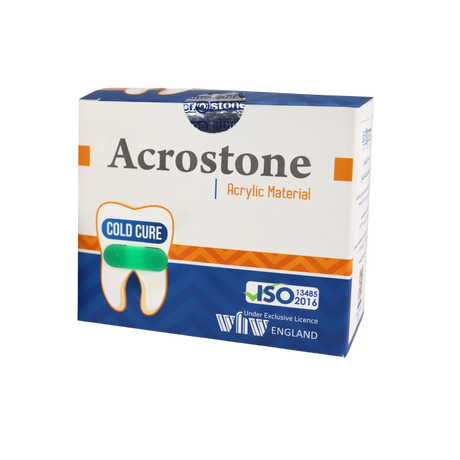
Acrostone
Acrostone Cold Cure green Special Tray
Low stock (15 units)Regular price From LE 340.00 EGPUnit price /Unavailable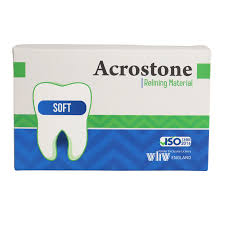
Acrostone
Very low stock (2 units)Regular price LE 1,375.00 EGPUnit price /Unavailable
Toothmate
Toothmate FixMate powder 50 gm
Very low stock (4 units)Regular price LE 299.00 EGPUnit price /Unavailable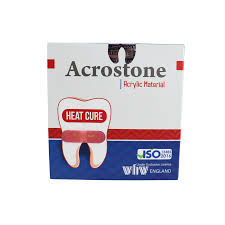
Acrostone
Low stock (9 units)Regular price LE 795.00 EGPUnit price /Unavailable


How to Choose the Right Denture Materials for Your Practice
- Acrylic type (cold-cure vs heat-cure) — Cold-cure PMMA resins polymerise at room temperature in 20–30 minutes, ideal for chairside repairs and custom tray construction. Heat-cure PMMA requires flasking at 70–100°C for ≥1 hour, producing denser bases with residual MMA monomer <0.2% and better long-term dimensional stability — the standard for definitive full dentures in Egyptian dental laboratories.
- Artificial teeth grade — PMMA acrylic sheet teeth (VITA A1–D4 shades) bond directly to the base resin and are the cost-effective standard in Egypt. Cross-linked composite teeth offer higher wear resistance (Vickers HV 25–40 vs HV 15–25 for PMMA) but require adhesive bonding protocols to prevent delamination during base curing.
- Powder-to-liquid ratio — A 3:1 powder-to-monomer ratio (by volume) is standard for cold-cure PMMA. Excess monomer increases residual MMA and porosity, reducing flexural strength below the ISO 1567 minimum of 65 MPa and raising biocompatibility concerns for long-term denture wearers.
- Monomer storage in Egypt's climate — MMA monomer degrades above 25°C. Egypt's summer heat (35–45°C) depletes the inhibitor, reducing working time from 5 minutes to under 2 minutes and risking spontaneous polymerisation. Store at 4–10°C in a sealed, light-protected container.
- Shade selection for Egyptian patients — Egyptian patients commonly present with warmer, higher-chroma dentition in the VITA A3–C3 range. Selecting sheet teeth matching the contralateral reference shade minimises chairside adjustment time and improves complete denture aesthetics.
- Relining indication — Soft liners (Shore A 10–40 durometer) are indicated for resorbed ridges where hard PMMA causes pressure soreness. Hard chairside reline with cold-cure acrylic is appropriate when vertical dimension is stable and ridge support is adequate.
Denture Material Types at a Glance
| Material | Type | Processing | Primary Use |
|---|---|---|---|
| Acrostone Cold Cure | Self-curing PMMA | Room temp, 20–30 min | Repairs, trays, chairside relines |
| Acrostone Special Tray | Self-curing PMMA (fast) | Room temp, <10 min | Custom impression trays |
| Acrostone Sheet Teeth | PMMA acrylic teeth | Bonded to base resin | Complete and partial denture aesthetics |
| Heat-cure PMMA | Conventional PMMA | Flask + boil 70–100°C | Definitive denture bases |
| Soft Liner | Silicone/acrylic resilient | Chairside or lab | Relining resorbed ridges |
Availability & Delivery in Egypt
MedSTA stocks Acrostone cold-cure resins, sheet teeth, and special tray acrylic in EGP, with same-day dispatch for Cairo and Giza orders and 2–5 day delivery to all Egyptian governorates. Products ship in sealed packaging appropriate to Egypt's summer ambient temperatures.
Frequently Asked Questions
What is the difference between cold-cure and heat-cure acrylic resin for denture fabrication?
What is the difference between cold-cure and heat-cure acrylic resin for denture fabrication?
Cold-cure PMMA polymerises at room temperature in 20–30 minutes using a chemical activator — suitable for chairside repairs, relining, and custom trays. Heat-cure PMMA requires flasking and processing at 70–100°C for at least one hour. Heat-cure produces denser bases with residual MMA below 0.2% and better dimensional stability, making it the standard for definitive full and partial denture bases in Egyptian dental laboratories.
What is the difference between PMMA sheet teeth and composite artificial teeth for dentures?
What is the difference between PMMA sheet teeth and composite artificial teeth for dentures?
PMMA acrylic sheet teeth bond chemically to the PMMA base and are straightforward to adjust in Egyptian laboratories. Composite (cross-linked polymer) teeth offer higher wear resistance (Vickers HV 25–40 vs HV 15–25 for PMMA) and improved surface gloss, but require adhesive bonding protocols to prevent delamination during base curing. For most Egyptian patients, PMMA teeth in VITA A–D shades remain the cost-effective standard.
How should denture acrylic resins and monomers be stored in Egyptian summer conditions?
How should denture acrylic resins and monomers be stored in Egyptian summer conditions?
MMA monomer must be stored at 4–10°C in a sealed, light-protected container. Egypt's summer temperatures (35–45°C) deplete the inhibitor rapidly, reducing working time from 5 minutes to under 2 minutes and risking spontaneous polymerisation. Store in a dedicated refrigerator and discard monomer showing yellowing or altered odour. PMMA powder should be kept in airtight containers to prevent moisture absorption in Egypt's humid coastal cities.
Can cold-cure acrylic resin be used for chairside denture repairs in Egyptian clinics?
Can cold-cure acrylic resin be used for chairside denture repairs in Egyptian clinics?
Yes. Cold-cure PMMA resins such as Acrostone Cold Cure are formulated for chairside denture repairs, direct tissue relining, and custom impression tray construction without laboratory equipment. The powder-liquid format allows the clinician to mix, apply, contour, and finish within a single appointment — the preferred approach for emergency denture repairs in Egyptian dental practices.
Does MedSTA supply Acrostone and other denture materials to dental laboratories across Egypt?
Does MedSTA supply Acrostone and other denture materials to dental laboratories across Egypt?
Yes. MedSTA supplies Acrostone cold-cure and special tray acrylic resins, PMMA sheet teeth in VITA shades, and denture accessories in EGP, with nationwide delivery to Cairo, Giza, Alexandria, Mansoura, and all other Egyptian governorates. In-stock items are dispatched from MedSTA's Cairo warehouse with same-day processing available.