
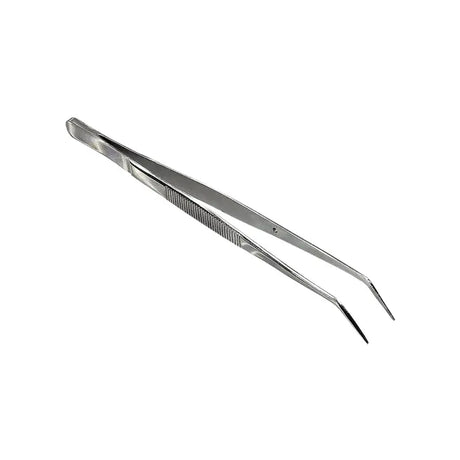
GENERIC
In stock (38 units)Regular price LE 49.00 EGPUnit price /Unavailable
Sedra dent
Low stock (19 units)Regular price LE 58.00 EGPUnit price /Unavailable
Premia
Very low stock (1 unit)Regular price LE 525.00 EGPUnit price /Unavailable
Premia
Very low stock (5 units)Regular price LE 410.00 EGPUnit price /UnavailableIntensiv
Intensive Diatweezer With Diamond -Coated Tip
Low stock (10 units)Regular price LE 2,800.00 EGPUnit price /Unavailable-

Premia
Premia Direct Band Bracket Tweezer with Blade
Very low stock (5 units)Regular price LE 410.00 EGPUnit price /Unavailable


How to Choose Dental Tweezers for Your Practice
- Tip Design (Smooth vs Serrated vs Curved) — Serrated tips provide better grip on cotton rolls and paper points that tend to slip in smooth-jaw forceps; smooth tips avoid tearing fragile materials such as platinum foil and thin matrix strips; angled (curved) tweezers improve access to posterior quadrants and lingual surfaces without the handle obscuring the operating field.
- Locking Mechanism (Plain vs Locking Ratchet) — Locking tweezers (ratchet lock) hold the item in place without sustained hand pressure — useful for placing and holding matrix bands, retraction cords, and rubber dam clamps in position while the other hand performs the procedure. Plain (non-locking) tweezers require continuous finger pressure and are better for rapid pick-and-place operations with cotton pellets.
- Buccal Tube Tweezers (Orthodontic) — Premia Buccal Tube Tweezers have an angled tip specifically designed for bonding and positioning buccal tubes on molar bands during orthodontic bracket placement. These are distinct from general cotton forceps in tip geometry and should not be confused with standard examination tweezers.
- Material (Stainless Steel vs Titanium-Coated) — Standard stainless steel tweezers withstand repeated Class B autoclaving; ensure they are made from AISI 420 or equivalent medical-grade stainless steel. Titanium-coated models resist staining from dental materials and corrosive irrigants (NaOCl) better than standard steel, extending clinical appearance.
- Overall Length (140 mm vs 150 mm) — 150 mm tweezers provide better reach into posterior quadrants without the clinician’s hand entering the operative area; 140 mm is standard for anterior and general use.
Dental Tweezers Available in Egypt
| Product | Tip | Lock | Price (EGP) |
|---|---|---|---|
| Standard Tweezer (Generic) | Serrated | No | 49 |
| Tweezer with Lock (Sedra dent) | Serrated | Ratchet | 58 |
| Tweezers (Bibodent) | Serrated | No | 40 |
| Premia Buccal Tube Tweezer | Angled ortho tip | No | 400 |
Availability & Delivery in Egypt
MedSTA supplies dental tweezers from Bibodent, Sedra dent, Premia, and generic brands in EGP with same-day dispatch from Cairo. Cairo and Giza delivery within 1–3 business days; all other Egyptian governorates within 3–5 business days.
Frequently Asked Questions
What is the difference between locking and non-locking dental tweezers?
What is the difference between locking and non-locking dental tweezers?
Non-locking cotton tweezers require continuous finger pressure to hold items — appropriate for rapid pick-and-place operations (cotton pellets, paper points) where items are transferred and immediately used. Locking tweezers (ratchet lock) clamp items in place without sustained pressure, freeing the clinician’s fingers to perform other tasks — ideal for holding retraction cord in position in the gingival sulcus, positioning rubber dam clamps, or steadying matrix bands while packing composite. Both types are required in a complete dental instrument setup.
Can dental tweezers be used to retrieve broken instruments from root canals?
Can dental tweezers be used to retrieve broken instruments from root canals?
Standard cotton tweezers do not have the precise tip geometry or spring force needed for fragment retrieval from root canal systems. Dedicated microsurgical forceps or endo retrieval kits (e.g. Woodpecker G8 ultrasonic tip + fine forceps) are required for broken file retrieval. Using standard tweezers risks further impacting the fragment or causing root perforation. Use cotton forceps only for their intended applications above the canal orifice.
How should dental tweezers be sterilised between patients?
How should dental tweezers be sterilised between patients?
Autoclave stainless steel dental tweezers using Class B cycles (134°C, 3 bar). Before autoclaving, clean the instrument in an ultrasonic bath with enzymatic detergent to remove blood, saliva, and dental material residue from the serrated tip surfaces. Dry thoroughly before loading into sterilisation pouches to prevent rust formation on hinge joints from residual moisture during the autoclave cycle. Inspect the hinge spring and tip alignment after every 50–80 autoclave cycles; replace the instrument if the spring weakens or tips are misaligned.
What type of tweezers should I use for placing retraction cord in the gingival sulcus?
What type of tweezers should I use for placing retraction cord in the gingival sulcus?
Use locking tweezers (ratchet lock, 150 mm length) for retraction cord placement. The locking mechanism allows you to grasp and tuck the cord into the gingival sulcus without losing grip during the packing procedure, and to hold the cord in position while transitioning between the Ultrapak cord packer and the tweezer. Serrated tips provide better grip on woven or knitted retraction cord than smooth tips. For paste retraction systems (e.g. Traxodent), tweezers are not used — follow the syringe-delivery protocol.
Does MedSTA supply dental tweezers from Bibodent and Sedra dent across Egypt?
Does MedSTA supply dental tweezers from Bibodent and Sedra dent across Egypt?
Yes — MedSTA supplies standard dental tweezers, locking tweezers (Sedra dent), Bibodent cotton forceps, and Premia Buccal Tube Tweezers in EGP with same-day dispatch from Cairo. Cairo and Giza delivery within 1–3 business days; all other Egyptian governorates within 3–5 business days.