

Profa
Profa C File st.st. Endo Hand File 25 mm
In stock (576 units)Regular price LE 155.00 EGPUnit price /Unavailable-
Rogin Dental
Very low stock (6 units)Regular price LE 170.00 EGPUnit price /Unavailable-
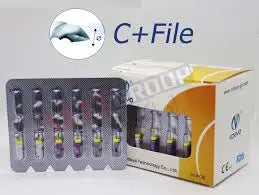
Videya
Very low stock (3 units)Regular price LE 160.00 EGPUnit price /Unavailable
Ramo Medical
Low stock (12 units)Regular price LE 182.00 EGPUnit price /Unavailable


How to Choose and Use C Files for Calcified Canal Negotiation
- C File Purpose (Scouting Only — Not Shaping) — C files are stainless steel pilot instruments in ISO sizes #06–#15 designed exclusively for negotiating and establishing patency in calcified, sclerotic, or previously untreated root canals where standard K-files deflect without penetrating. They are not enlargement or shaping instruments. Once the canal is successfully negotiated with a C file, transition to standard K files (#10 or #15) for initial preparation and then your regular shaping sequence.
- Semi-Rigid vs K File Flexibility — At the same ISO size, C files have greater stiffness than standard K-flex files and are slightly stiffer than standard K files at sizes #06–#15. This extra stiffness allows the C file tip to probe calcified dentine without deflecting off the mineralized bridge — the key property that makes it effective where standard K-file access has been defeated.
- EDTA Lubrication (Mandatory) — Always apply EDTA cream or solution (RC-Prep, Canal+) at the canal orifice before and throughout C file use. EDTA chelates calcium ions from calcified dentine, progressively softening the mineral obstruction. Without EDTA, C files probe against hardened tissue without chemically clearing a pathway, dramatically increasing the effort required and the fracture risk from over-stress.
- Technique (Watch-Winding + Gentle Apical Pressure) — Insert with a light watch-winding motion (quarter-turn clockwise/anticlockwise) while applying gentle, steady apical pressure. Never force the instrument. If resistance is felt and the file does not advance, withdraw, re-apply EDTA, wait 30 seconds, and retry. Periapical radiographic verification every 2–3 mm confirms the file is following the original canal path.
- Single-Use After Each Canal — C files are small, high-stress instruments used in the most demanding canal geometry. Discard after each canal regardless of visible deformation. Cyclic stress from watch-winding in calcified dentine at tip sizes #06–#15 generates metal fatigue with repeat use, even when the file looks intact externally.
C File Clinical Decision Guide
| Situation | Recommended Action | File Type |
|---|---|---|
| Standard root canal, no calcification | Start with K file #10 for patency | Standard K file |
| Calcified orifice, K #10 deflects | C file #06 or #08 + EDTA | C file |
| Sclerotic canal, no visible orifice | Ultrasonic activation + C file + EDTA | C file after ultrasonic |
| Prior canal attempted, needs re-scouting | C file to reconfirm patency | C file |
Availability & Delivery in Egypt
MedSTA stocks C files from Fanta, Profa, Rogin Dental, and other trusted brands, priced from 155–170 EGP per pack, delivered to endodontic and general practices across Cairo, Giza, Alexandria, and all Egyptian governorates. Store in dry, sealed conditions — small-diameter stainless steel tips are susceptible to surface micro-corrosion from humidity that degrades tip sharpness before clinical use.
Frequently Asked Questions
What is a C file and how does it differ from a standard K file?
What is a C file and how does it differ from a standard K file?
C files (C-pilot files) are semi-rigid stainless steel endodontic hand instruments in ISO sizes #06–#15 designed specifically for scouting calcified or previously untreated root canals. Their extra stiffness at small tip diameters allows them to probe and penetrate calcified dentinal bridges without deflecting off the mineralized tissue — the critical difference from standard K files of the same size, which deflect in calcified anatomy.
When should I use a C file instead of a standard number 10 K file?
When should I use a C file instead of a standard number 10 K file?
Use a C file when a standard #10 K file cannot negotiate the canal to working length because the file deflects or loses its path in calcified or sclerotic dentine. C files provide greater stiffness at sizes #06–#15, allowing probing with gentle apical pressure where K files simply bend away. Always use EDTA lubricant throughout C file use to chelate mineral deposits and progressively soften the obstruction.
Can C files be used for canal enlargement and shaping?
Can C files be used for canal enlargement and shaping?
No. C files are scouting instruments only, used in ISO sizes #06–#15 for patency and initial canal negotiation. They are not designed for canal enlargement or step-back preparation. Once the canal has been successfully negotiated to working length, transition to standard K files (#10 or #15) for initial preparation, then to your regular rotary or hand file shaping sequence.
What technique is recommended for negotiating a calcified canal with C files?
What technique is recommended for negotiating a calcified canal with C files?
Apply EDTA cream or gel at the canal orifice and allow 30 seconds for chelation to begin. Insert the C file with a light watch-winding motion (quarter-turns) while applying gentle steady apical pressure. Do not force. If the file does not advance, withdraw, re-apply EDTA, and retry. Periapical radiographs every 2–3 mm confirm you are following the original canal anatomy. Ultrasonic activation of EDTA before C file use improves patency rates in severely calcified Egyptian cases.
Does MedSTA supply C files to endodontic practices across Egypt?
Does MedSTA supply C files to endodontic practices across Egypt?
Yes. MedSTA delivers C files from Fanta, Profa, Rogin Dental, and other brands to endodontic and general practices across Cairo, Giza, Alexandria, and all Egyptian governorates, priced in EGP with fast nationwide delivery.