
-

Sedra dent
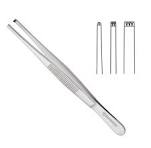
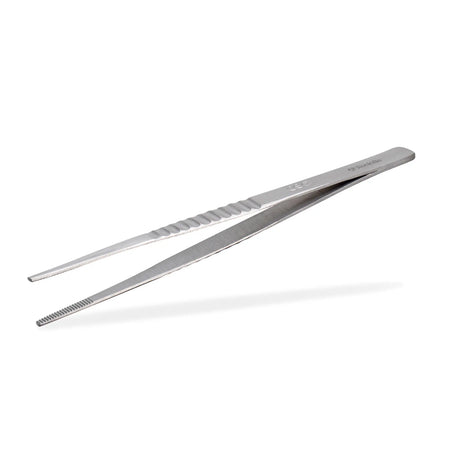
Sedra Suture Pliers Suture Forceps Angled
Very low stock (5 units)Regular price LE 458.00 EGPUnit price /Unavailable

How to Choose the Right Tissue Forceps for Your Practice
- Jaw Design: Toothed vs Non-Toothed — Toothed tissue forceps (1×2 or 2×3 interlocking teeth) provide a secure mechanical grip on dense fibrous tissue and periosteum, resisting slippage under retraction tension — essential during flap reflection and closure. Non-toothed (smooth serrated jaw) variants are preferred for delicate mucosal tissue where tooth penetration would cause tearing; the choice is dictated by tissue density and the acceptable risk of puncture, not personal preference.
- Pattern and Tip Geometry — Standard tissue forceps (dressing-style, straight jaw) suit most intraoral soft-tissue grasping tasks. The Adson pattern narrows to a fine 1×2 serrated tip for precise mucosal work in restricted posterior or interdental sites. Adson-Brown variants carry multi-point fine teeth for atraumatic mucosal handling during plastic surgery-style closures. Selecting the correct tip geometry reduces tissue trauma and improves suture needle placement accuracy.
- Material and Autoclave Durability — High-grade stainless steel (AISI 420 or AISI 410, passivated surface) resists corrosion through repeated autoclave sterilisation at 134 °C and 3–4 bar. Instruments showing surface pitting, rust, or spring fatigue before 200 cycles indicate sub-grade alloy or inadequate passivation — inspect regularly and replace before instrument failure compromises asepsis.
- Handle Length and Working Balance — Standard handle lengths (14–15 cm) balance well for most intraoral access. Longer handles (16–18 cm) improve reach for posterior mandible and floor-of-mouth procedures but reduce tactile feedback at the tip. For microsurgical or periodontal flap work under magnification, shorter lightweight handles (10–12 cm) improve proprioception and instrument control.
- Spring Tension and Fatigue Life — The spring mechanism governs opening resistance and closing precision. Insufficient tension causes jaws to drift open under load; excessive tension accelerates operator fatigue during extended procedures. Quality instruments maintain consistent spring tension for at least 500 sterilisation cycles — inspect the pivot and spring interface for deformation at each cleaning cycle.
- Set Compatibility with Needle Holders and Scissors — Tissue forceps are routinely used alongside needle holders and suture scissors during closure. Purchasing matched sets from a consistent manufacturer ensures uniform handle profiles and weight distribution, reducing instrument confusion during gloved, time-critical closure steps.
Tissue Forceps Patterns at a Glance
| Pattern | Tip Design | Primary Use | Best Tissue Type |
|---|---|---|---|
| Standard Toothed (1×2) | 1×2 interlocking teeth | Flap elevation, periosteal manipulation | Dense fibrous or periosteal tissue |
| Standard Non-Toothed | Smooth serrated jaws | Mucosal retraction, delicate closure | Thin or fragile mucosal tissue |
| Adson (1×2) | Fine 1×2 teeth, narrow tip | Precision mucosal grasping, suture placement | Thin mucosa, restricted access sites |
| Adson-Brown | Multi-point fine teeth, narrow tip | Atraumatic mucosal handling, microsurgery | Delicate mucosa, periodontal flaps |
| Suture Forceps (angled) | Angled serrated jaw | Suture needle placement and knot tying | All soft tissue during closure |
Availability & Delivery in Egypt
MedSTA supplies tissue forceps to dental practices and oral surgery clinics across Egypt — Cairo, Giza, Alexandria, and all governorates — with transparent EGP pricing and fast nationwide delivery. Both branded lines (ASA, Sedra, Premia) and economy-grade options are stocked, covering every procurement budget without compromising on AISI 420-grade stainless steel construction. In Egypt’s humid coastal and high-temperature inland conditions, instruments should be dried thoroughly after ultrasonic cleaning and stored in sealed instrument trays to prevent surface oxidation between sterilisation cycles.
Frequently Asked Questions
What is the difference between toothed and non-toothed tissue forceps?
What is the difference between toothed and non-toothed tissue forceps?
Toothed tissue forceps have interlocking teeth (typically 1×2 or 2×3) that grip dense fibrous tissue and periosteum securely without slipping under tension, making them the standard choice for flap elevation and periosteal manipulation. Non-toothed (smooth-jaw) tissue forceps use fine serrations to grip delicate mucosal tissue without puncture, reducing the risk of tearing thin or inflamed mucosa during retraction and closure.
Which tissue forceps pattern is best for suturing in the oral cavity?
Which tissue forceps pattern is best for suturing in the oral cavity?
Adson-pattern tissue forceps with fine 1×2 teeth or Adson-Brown multi-point tips are preferred for suturing in the oral cavity because the narrow tip provides precision placement next to the suture needle without crushing surrounding tissue. Standard toothed forceps work for interrupted sutures in dense tissue, but the Adson pattern offers better control in restricted posterior and interdental sites where working space is limited.
Can tissue forceps be sterilised in a dental autoclave?
Can tissue forceps be sterilised in a dental autoclave?
Yes. Tissue forceps made from AISI 420 or AISI 410 stainless steel are fully autoclave-compatible and must be sterilised at 134 °C and 3–4 bar in a class B or N cycle between each patient use. Clean ultrasonically first, rinse, dry thoroughly, and package before each cycle. In Egypt’s humid conditions, store instruments in sealed trays between cycles to prevent surface oxidation and inspect for pitting or rust at each cleaning pass.
How often should tissue forceps be replaced in a busy dental practice?
How often should tissue forceps be replaced in a busy dental practice?
Quality AISI 420 stainless tissue forceps should reliably perform through 500 or more sterilisation cycles when correctly cleaned, dried, and stored. In high-volume practices, inspect the spring mechanism for fatigue, jaw tips for misalignment, and surfaces for pitting after every 100 cycles. In Egypt’s coastal clinics where ambient humidity is higher, surface oxidation can shorten service life — replace instruments showing spring fatigue or jaw mismatch promptly to avoid compromising closure integrity.
Does MedSTA supply tissue forceps across all Egyptian governorates?
Does MedSTA supply tissue forceps across all Egyptian governorates?
Yes. MedSTA delivers tissue forceps to dental clinics and oral surgery facilities in Cairo, Giza, Alexandria, and all Egyptian governorates with transparent EGP pricing and fast nationwide dispatch. Multiple brands and grades are stocked — including ASA, Sedra, and Premia — so practices can order economy and premium instruments in a single order without minimum quantity requirements.