

GENERIC
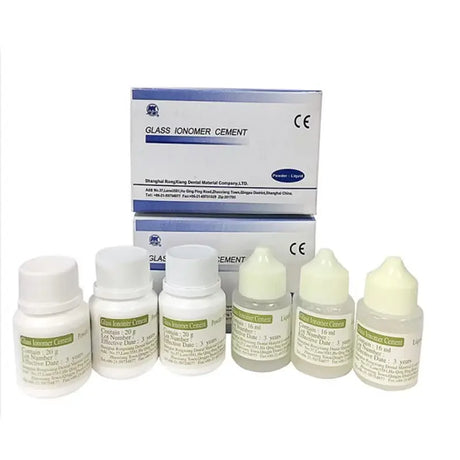
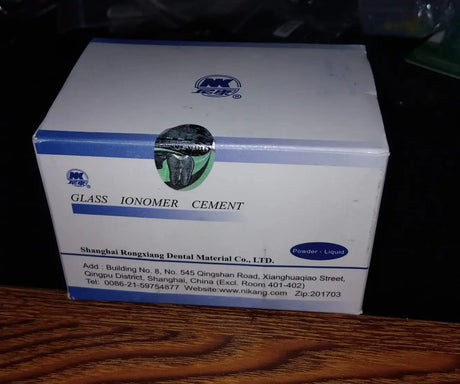
GLASS IONOMER CEMENT - CHINA - 20g and 15ml
Very low stock (7 units)Regular price From LE 90.00 EGPUnit price /Unavailable-
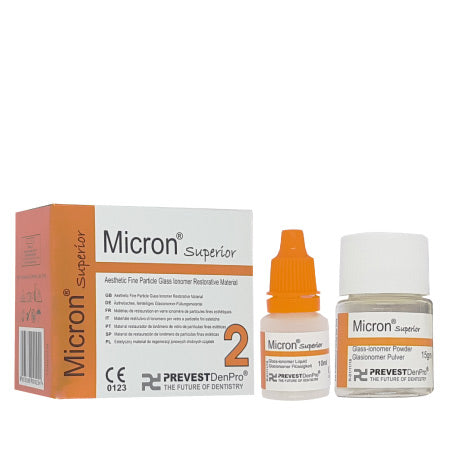
prevest Denpro
Prevest Micron II Superior Glass Ionomer Cement and Filling 15 g powder + 10ml Liquid
Very low stock (4 units)Regular price LE 560.00 EGPUnit price /Unavailable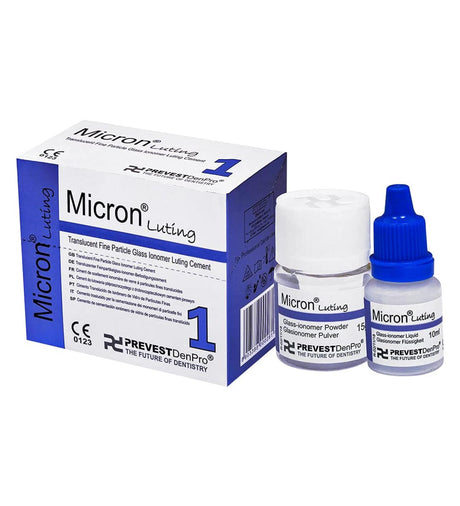
prevest Denpro
Prevest Micron Luting Glass Ionomer Cement 15gm and 10ml
Very low stock (8 units)Regular price LE 550.00 EGPUnit price /Unavailable
Promedica
PROMEDICA Medicem Glass Ionomer Cement 35gm&15ml
Very low stock (5 units)Regular price LE 1,965.00 EGPUnit price /Unavailable
Voco
VOCO Meron Plus AC Capsules 1 capsule
In stock (37 units)Regular price LE 120.00 EGPUnit price /Unavailable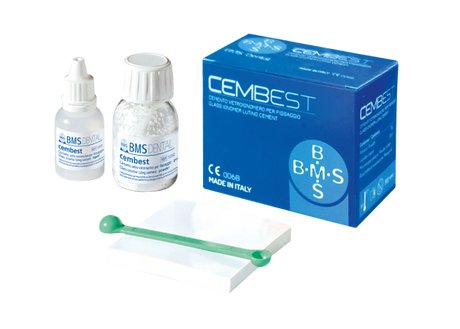
BMS
BMS CEMBEST 35 gr Powder 20 ml Liquid
In stock (39 units)Regular price LE 1,850.00 EGPUnit price /Unavailable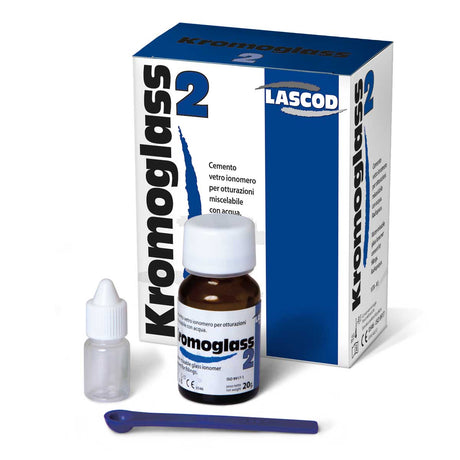
Lascod
Kromoglass2 Glass Ionomer Cement and filling 20 g
Low stock (10 units)Regular price LE 1,450.00 EGPUnit price /Unavailable
GC
Very low stock (3 units)Regular price LE 3,800.00 EGPUnit price /Unavailable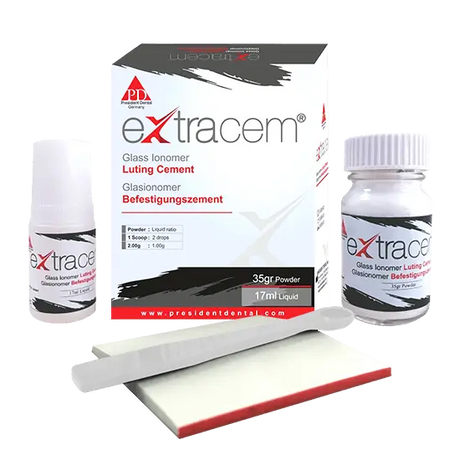
PD Germany
PD ExtraCem - Glass Ionomer Luting Cement - Powder 35 gr+ 17 ml Liquid
Low stock (18 units)Regular price LE 1,800.00 EGPUnit price /Unavailable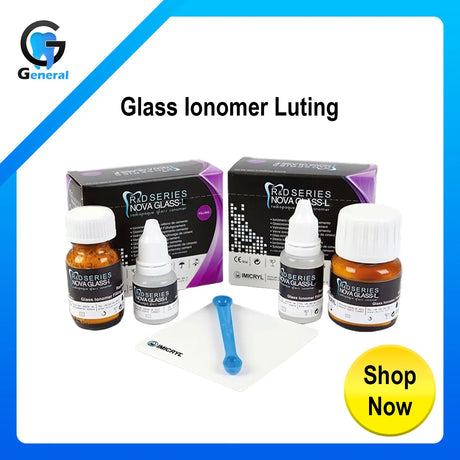
imicryl
Nova Glass-L Glass Ionomer Luting Cement 15g powder + 6.8 ml Liquid
Low stock (10 units)Regular price LE 725.00 EGPUnit price /Unavailable
OT Dent
OT Glass L1 Glass Ionomer Luting Cement
Low stock (19 units)Regular price LE 400.00 EGPUnit price /Unavailable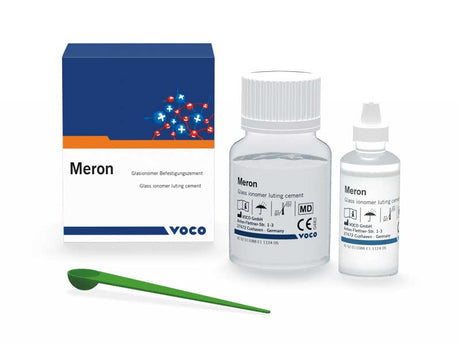
Voco
Meron Glass ionomer luting cement powder 35 g / liquid 15 ml
Very low stock (4 units)Regular price LE 2,199.00 EGPUnit price /Unavailablevincismile
Vincismile Glass Ionomer Cement Luting I 30 gm powder 25 gm liquid
Low stock (10 units)Regular price LE 1,645.00 EGPUnit price /Unavailable-

WP DENTAL
WP SecuraFix Glass ionomer cement 24 g powder, 10 g liquid + dosing spoon
Low stock (10 units)Regular price LE 1,295.00 EGPUnit price /Unavailable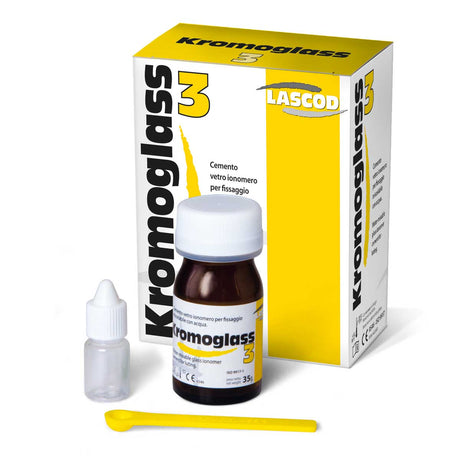
Lascod
Kromoglass3 glass ionomer cement 35 g
Low stock (10 units)Regular price LE 1,660.00 EGPUnit price /Unavailable


How to Choose the Right Glass Ionomer Cement for Your Practice
- GIC Type Classification (ISO 9917) — ISO 9917 defines four clinical types: Type I (luting — low film thickness ≤25 µm, for cementation of crowns and bridges), Type II (restorative — higher compressive strength for Class III/V cavities and primary teeth), Type III (base and liner — flows under condensation pressure), and resin-modified GIC (RMGIC — light-cured, improved early moisture resistance). Selecting the wrong type for the application compromises marginal seal and fracture resistance.
- Fluoride Release Profile — Conventional GIC releases fluoride via an ion-exchange reaction with hydroxyapatite — highest in the first 24 hours, then sustained at lower levels long-term. This caries-inhibitory effect is clinically meaningful around high-risk margins but should not be cited as a substitute for adequate cavity preparation. RMGIC releases less fluoride than conventional GIC due to the resin matrix, which must be weighed against its improved moisture tolerance in newly erupted or difficult-to-isolate teeth.
- Powder-to-Liquid Ratio Compliance — Hand-mixed GIC is highly ratio-sensitive: under-loading powder produces a weak, soluble set; over-loading reduces flow and elevates film thickness above the luting tolerance. Always use the manufacturer-supplied scoop and leveller rather than estimating by eye. Capsule-delivery systems (e.g. GC Fuji II LC capsule, VOCO Meron Plus AC) eliminate ratio variation entirely and are strongly preferred for luting applications where film thickness directly affects crown seating.
- Compressive Strength vs. Clinical Application — Restorative GIC (Type II) should achieve compressive strength of 130–180 MPa after full set. Values below 120 MPa indicate an under-loaded mix or premature moisture contamination. For stress-bearing posterior restorations in permanent teeth, compressive strength alone is insufficient — consider RMGIC or resin composite with a GIC base rather than conventional GIC as the primary restorative material.
- Early Moisture Sensitivity — Conventional GIC is highly vulnerable to moisture contamination during the initial set phase (0–5 minutes post-mix) and to desiccation after setting. In Egypt's dry interior climate, apply varnish or Vaseline immediately after insertion to prevent surface crazing. RMGIC is significantly less moisture-sensitive during setting and is preferred for paediatric cases where isolation is difficult.
- Capsule vs. Hand-Mix Selection — Capsule delivery (GC Fuji, VOCO Meron, Ketac series) provides consistent mix ratio, no cross-contamination, and faster chairside throughput at higher cost per unit. Hand-mixed systems (Prevest Micron, generic GIC) offer lower per-restoration cost and are appropriate for high-volume practices with trained support staff who can maintain reliable powder-liquid ratios. Evaluate total cost per case rather than unit price alone when choosing between formats.
Glass Ionomer Cement Types at a Glance
| Type | ISO Classification | Key Property | Primary Clinical Use |
|---|---|---|---|
| Conventional GIC — Luting | Type I (ISO 9917) | Film thickness ≤25 µm | Cementation of cast metal, PFM, and post/core |
| Conventional GIC — Restorative | Type II (ISO 9917) | Compressive strength 130–180 MPa | Class III/V restorations, primary teeth, tunnel prep |
| Conventional GIC — Base/Liner | Type III (ISO 9917) | Flows under condensation; fluoride release | Cavity base under composite or amalgam |
| Resin-Modified GIC (RMGIC) | Type II variant | Light-cured; moisture-tolerant; reduced fluoride | Paediatric restorations, Class V cervical lesions |
| Capsule-Delivery GIC | Types I/II | Consistent P/L ratio; reduced chairside time | High-volume luting, mixing consistency critical |
Availability & Delivery in Egypt
MedSTA stocks a full range of glass ionomer cement formats — from economy hand-mix GIC (225–560 EGP) to premium capsule systems such as GC Fuji II LC and VOCO Meron Plus AC — all priced in EGP and delivered to dental clinics across Cairo, Giza, Alexandria, and all Egyptian governorates. In Egypt's warm storage conditions, GIC liquid is sensitive to temperature fluctuation: store away from direct sunlight, never in a refrigerator unless the manufacturer specifies otherwise, and discard liquid that has become viscous or shows precipitation.