
GENERIC
Low stock (13 units)Regular price From LE 50.00 EGPUnit price /Unavailable-
-

GENERIC
In stock (35 units)Regular price From LE 130.00 EGPUnit price /UnavailableSedra dent
Very low stock (7 units)Regular price LE 495.00 EGPUnit price /Unavailable-

Miltex
Very low stock (5 units)Regular price LE 895.00 EGPUnit price /Unavailable
Ultradent
Very low stock (3 units)Regular price LE 115.00 EGPUnit price /Unavailable
Ultradent
Very low stock (2 units)Regular price LE 280.00 EGPUnit price /UnavailableSedra dent
Very low stock (8 units)Regular price LE 495.00 EGPUnit price /Unavailable-

Hufriedy
Very low stock (2 units)Regular price LE 780.00 EGPUnit price /Unavailable
Kerr
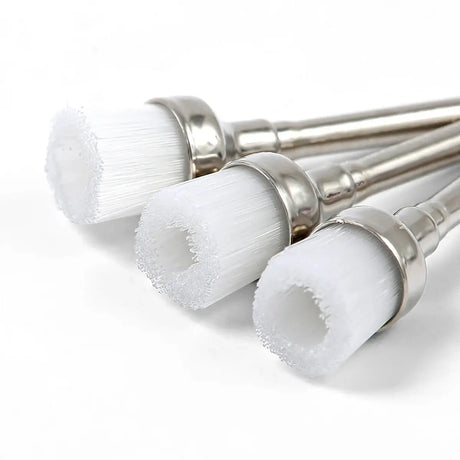
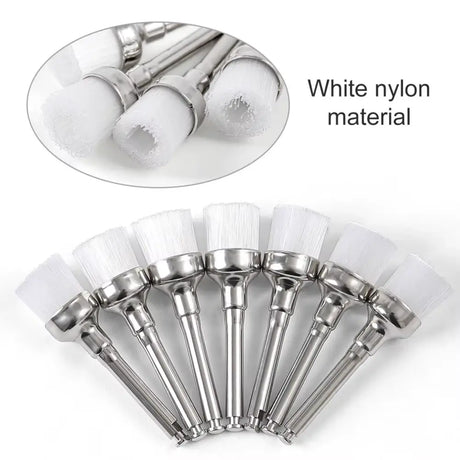
Kerr OptiShine first concave-shaped polishing brush
Low stock (10 units)Regular price From LE 383.00 EGPUnit price /Unavailable
Sedra dent
Sedra Nabers periodontal probe
Very low stock (8 units)Regular price LE 410.00 EGPUnit price /Unavailable
Premia
Very low stock (3 units)Regular price LE 450.00 EGPUnit price /Unavailable
Hufriedy
Very low stock (4 units)Regular price LE 399.00 EGPUnit price /Unavailable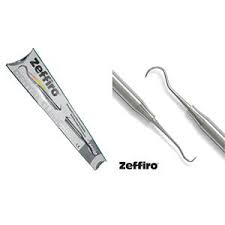
Lascod
In stock (40 units)Regular price LE 725.00 EGPUnit price /Unavailable






How to Choose the Right Periodontal Instruments for Your Practice
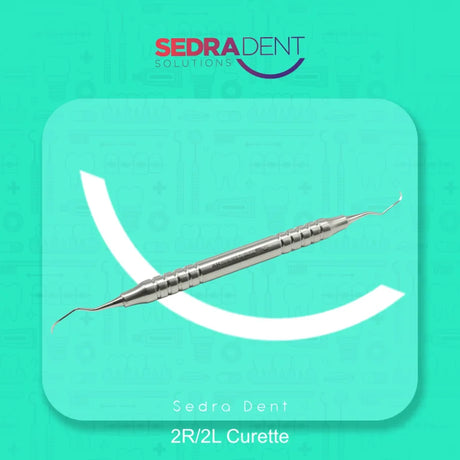
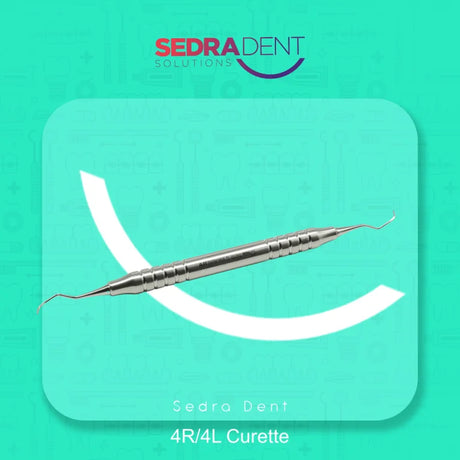
- Curette Design: Universal vs Gracey — Universal curettes (Columbia 4R/4L, Barnhart) have two cutting edges and can be used on any tooth surface from any approach angle, making them practical for Egyptian general practitioners performing non-surgical periodontal therapy. Gracey curettes are area-specific, with a single cutting edge and distinct shank angulations (Gracey 1/2 for anteriors, 11/12 for mesial molars, 13/14 for distal molars) providing superior subgingival access and root planing efficiency in deep periodontal pockets exceeding 5 mm.
- Curette Blade Cross-Section and Edge Geometry — Gracey curette blades have a convex back and a cutting edge offset at 70 degrees from the shank for correct subgingival angulation. Blade cross-section (toe-to-heel length) determines access in narrow proximal pockets; mini-bladed Gracey instruments (Gracey After 5, Micro 11/12) access furcation areas and narrow 2-3 mm pockets better than standard blade lengths in Egyptian patients with advanced chronic periodontitis.
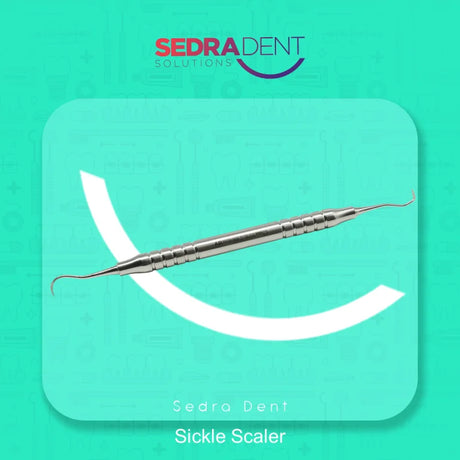
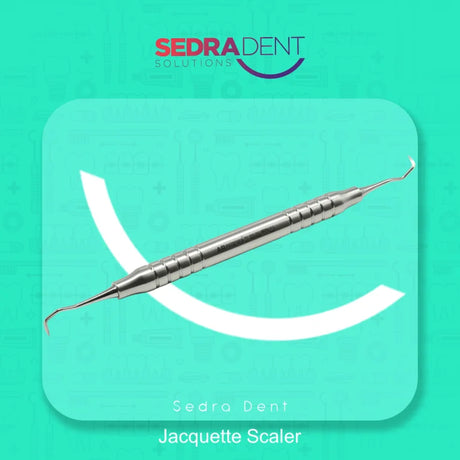
- Scaler Tip Geometry — Sickle scalers (H6/H7, Jacquette) remove supragingival calculus and heavy subgingival deposits within 1-2 mm below the gingival margin using pull strokes. The sharp pointed tip allows access to open contacts and interproximal areas. For Egyptian patients with heavy tobacco-stained calculus deposits, sickle scalers in AISI 316L with regularly sharpened edges are more efficient than hand files or hoes for initial gross debridement before ultrasonic scaling.
- Probe Calibration System — Williams probes (colour-banded at 1/2/3/5/7/8/9/10 mm) enable full-mouth pocket charting with BOP (bleeding on probing) recording at 6 sites per tooth. WHO probes (3.5/5.5/8.5/11.5 mm, ball-ended) facilitate CPITN screening in Egyptian epidemiological surveys and public dental health assessments. For computerised periodontal charting, probes compatible with electronic recording systems are available.
- Steel Grade and Sharpening Maintenance — Periodontal instruments in AISI 316L maintain their cutting edge geometry across repeated autoclave cycles and Arkansas stone sharpening sessions. Lower-grade steel (AISI 420) loses edge geometry faster, requiring more frequent replacement in Egyptian clinics performing multiple scaling and root planing sessions daily. Instruments should be tested against an acrylic sharpening stick and resharpened when they no longer reflect light from the cutting edge.
Periodontal Instruments at a Glance
| Instrument | Type | Key Specification | Periodontal Application |
|---|---|---|---|
| Gracey curette 13/14 | Area-specific curette | Single cutting edge, 70 degree offset, AISI 316L | Distal molar subgingival root planing |
| Columbia 4R/4L | Universal curette | Two cutting edges, straight shank | Any surface non-surgical root debridement |
| Sickle scaler H6/H7 | Sickle scaler | Sharp triangular cross-section, AISI 316L | Supragingival calculus removal |
| Williams probe | Periodontal probe | 1/2/3/5/7/8/9/10 mm, colour-banded | Pocket depth, BOP, clinical attachment level |
| WHO probe (CPITN) | Screening probe | Ball-end tip, 3.5/5.5/8.5/11.5 mm | Periodontal screening, epidemiological surveys |
Availability and Delivery in Egypt
MedSTA stocks periodontal instruments from Sedra dent, Bibodent, and international manufacturers including Hu-Friedy equivalents across EGP price points for Egyptian periodontists and general practitioners. Both individual instruments and complete Gracey curette sets (1/2 through 13/14) are available. Orders dispatch from Cairo with nationwide delivery to all Egyptian governorates.
Frequently Asked Questions
What is the difference between Gracey curettes and universal curettes for periodontal treatment?
What is the difference between Gracey curettes and universal curettes for periodontal treatment?
Universal curettes (such as Columbia 4R/4L) have two parallel cutting edges and can be used on any tooth surface from multiple approach angles, making them practical for general practitioners performing non-surgical periodontal therapy in Egyptian clinics. Gracey curettes are area-specific instruments with a single cutting edge offset at 70 degrees from the face of the blade; different Gracey numbers are designed for specific tooth surfaces (1/2 for anteriors, 11/12 for mesial molars, 13/14 for distal molars), providing superior access to subgingival root surfaces in pockets exceeding 5 mm depth.
How do I know when a periodontal curette needs sharpening?
How do I know when a periodontal curette needs sharpening?
A curette needs sharpening when its cutting edge no longer scrapes cleanly across an acrylic sharpening test stick and instead slides without catching. Visually, a sharp cutting edge appears as a fine, dark line when viewed under magnification; a dull edge reflects light as a bright white line along the blade. In Egyptian periodontal practices performing multiple scaling and root planing procedures daily, Gracey curettes typically require sharpening every 3-5 uses with an Arkansas stone to maintain effective calculus removal efficiency and reduce clinician hand fatigue.
Can hand scalers replace ultrasonic scaling in Egyptian dental practice?
Can hand scalers replace ultrasonic scaling in Egyptian dental practice?
Hand scalers and curettes provide root surface debridement that ultrasonic scalers cannot fully replicate, particularly in removing embedded calculus from root surface irregularities and performing definitive subgingival root planing to achieve a smooth, biologically compatible surface. Current evidence supports a combined approach: ultrasonic scaling for efficient bulk calculus removal and aerosol control using piezoelectric units (available at MedSTA), followed by hand instrument root planing with Gracey curettes for subgingival finishing. Hand instruments alone remain the standard for definitive root planing in narrow furcation areas inaccessible to ultrasonic tips.
How should periodontal instruments be maintained in Egyptian clinics to maximise service life?
How should periodontal instruments be maintained in Egyptian clinics to maximise service life?
Periodontal instruments in Egyptian clinics should be cleaned immediately after use using ultrasonic cleaning solutions before autoclaving to prevent dried blood and calculus from fusing to the metal surface. AISI 316L instruments tolerate repeated Class B autoclave cycles at 134 degrees C without losing temper or edge geometry; AISI 420 grade instruments should be lubricated with instrument milk before each autoclave cycle to prevent surface oxidation. Arkansas sharpening stones should be used with instrument oil for Gracey curette sharpening rather than dry stones, which generate excessive heat and may microscopically alter cutting edge metallurgy.
Does MedSTA supply complete periodontal instrument sets for Egyptian periodontists?
Does MedSTA supply complete periodontal instrument sets for Egyptian periodontists?
MedSTA supplies individual periodontal instruments and complete sets including full Gracey curette series (1/2 through 15/16), Williams and WHO probes, sickle scalers, and ultrasonic perio tips from Sedra dent, Bibodent, and Woodpecker brands across EGP price points for Egyptian periodontists and general practitioners. Both economy student-grade sets and precision instruments suited to specialist periodontal practices are available. Orders dispatch from Cairo with nationwide delivery to all Egyptian governorates including specialist periodontal centres in Alexandria, Giza, and Assiut.