
Woodpecker
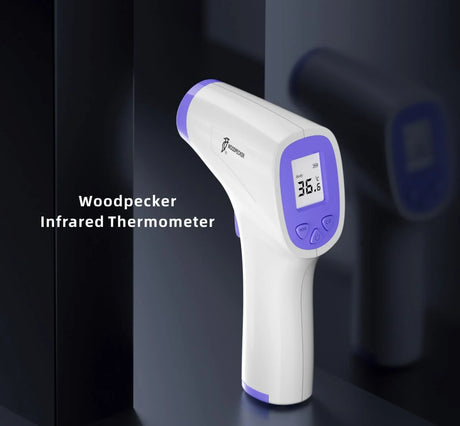
Woodpecker Infra-red thermometer
Very low stock (4 units)Regular price LE 770.00 EGPUnit price /Unavailable
How to Choose the Right Dental Infrared Thermometer for Your Practice
- Measurement Accuracy — clinical-grade infrared thermometers read within ±0.2–0.3°C of core body temperature per ASTM E1965, while uncertified consumer units can drift ±0.5°C or more.
- Measurement Distance and Mode — forehead mode at 3–5 cm suits fast patient triage; object mode (for equipment or surface temperature) requires a different emissivity setting than skin mode (typically 0.95 for skin).
- Response Time — a sub-1-second readout prevents a bottleneck at reception during peak clinic hours.
- Memory and Silent Mode — 20–32 reading memory helps track repeat patients; silent mode avoids startling anxious patients, useful in pediatric dental practices.
- Battery Type and Calibration Interval — most units run on AA/AAA batteries and should be recalibrated or replaced annually to maintain accuracy against the ASTM standard.
- Certification — look for CE- or FDA-cleared medical device status rather than uncalibrated consumer thermometers sold without clinical certification.
Infrared Thermometer Grades at a Glance
| Feature | Clinical-Grade IR Thermometer | Consumer-Grade IR Thermometer |
|---|---|---|
| Accuracy | ±0.2–0.3°C | ±0.5°C or more |
| Certification | CE/FDA medical device | Often uncertified |
| Measurement modes | Forehead + object mode | Forehead only |
| Memory | 20–32 readings | None or minimal |
| Typical use | Clinical patient screening | General household use |
Availability & Delivery in Egypt
MedSTA stocks the Woodpecker infrared thermometer at approximately EGP 770. Orders within Cairo and Giza are typically fulfilled within 1–2 business days; delivery to other governorates takes 2–4 business days.
Frequently Asked Questions — Dental Infrared Thermometers
How accurate are infrared thermometers compared to oral or ear thermometers?
How accurate are infrared thermometers compared to oral or ear thermometers?
Forehead infrared readings typically run about 0.3–0.5°C lower than oral or tympanic readings because they measure surface skin temperature rather than core temperature. Clinical-grade units compensate with an internal offset, but oral thermometers remain more accurate for confirming a borderline fever.
What distance should I hold an infrared thermometer from the patient's forehead?
What distance should I hold an infrared thermometer from the patient's forehead?
Most clinical infrared thermometers are calibrated for a 3–5 cm measuring distance. Holding the device too close or too far from this range introduces measurement error, so check the manufacturer's specified distance before each use.
Can infrared thermometers measure equipment surface temperature, not just patients?
Can infrared thermometers measure equipment surface temperature, not just patients?
Yes, switching to object mode allows the same device to check autoclave or sterilizer surface temperatures, but the emissivity setting must be adjusted since metal and plastic surfaces reflect infrared differently than skin.
How often should a clinic's infrared thermometer be recalibrated?
How often should a clinic's infrared thermometer be recalibrated?
Manufacturers generally recommend annual recalibration or replacement to keep readings within the ASTM E1965 accuracy band, especially for units used daily at high patient volume.
Does Egypt's ambient heat affect infrared thermometer readings in clinics without air conditioning?
Does Egypt's ambient heat affect infrared thermometer readings in clinics without air conditioning?
Yes, infrared sensors are sensitive to large swings in ambient temperature; readings taken in a hot waiting room can run higher than in a climate-controlled reception area. Allow the device to acclimatize for a few minutes after moving it between rooms, and recalibrate periodically. MedSTA delivers infrared thermometers across Egypt.