
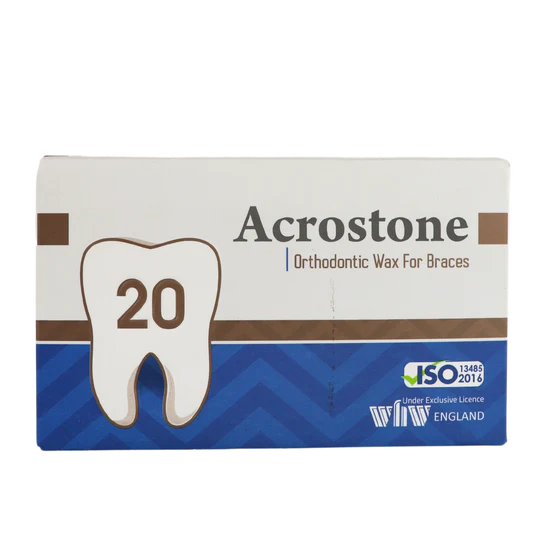
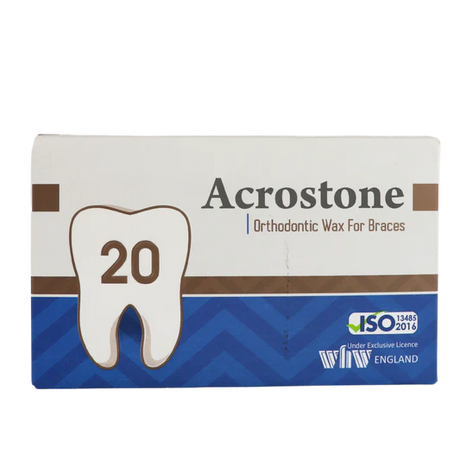
Acrostone
Acrostone Orthodonic Wax For Braces
Low stock (10 units)Regular price From LE 15.00 EGPUnit price /Unavailable
How to Choose the Right Orthodontic Wax for Your Patients
- Paraffin vs Microcrystalline Wax Base — Standard orthodontic wax uses a paraffin base (melting point approximately 50–57°C), which is soft at body temperature and easy to mould. Microcrystalline variants are slightly harder at room temperature but more adhesive to bracket surfaces — they stay in place longer during eating and speaking. In Egypt's summer heat, paraffin wax stored in a car or bag pocket can soften and lose shape before use — microcrystalline wax has better heat resistance for outdoor use.
- Standard vs Flavoured Formulations — Unflavoured white wax is standard and acceptable to most adult patients. Flavoured variants (mint, orange, strawberry) significantly improve compliance in Egyptian adolescent patients — the primary orthodontic demographic — by making wax application less aversive. Acrostone's flavoured orthodontic wax is formulated specifically for this market.
- Wax Strip Size and Shape — Standard strips (approximately 5 cm × 1 cm) are sufficient for 3–4 bracket positions per strip. Pre-scored or individually wrapped strips reduce chairside dispensing time. For home use by patients, provide 2–3 strips per patient per visit and instruct on correct application technique — many Egyptian patients first present with bracket irritation because they did not receive wax at initial bonding.
- Indications (When to Recommend) — Recommend orthodontic wax at every bonding appointment as standard. Primary indications: new bracket placement (first 1–2 weeks); protruding wire end before trimming appointment; loose or broken bracket awaiting repair; gingival irritation from lower incisor bracket margins during levelling. Not intended as a substitute for trimming overlong wires.
- Application Technique for Patients — Dry the bracket area with a tissue before application. Pinch a small piece of wax, warm it briefly between fingers, and press firmly over the offending bracket or wire end with a rolling motion. The wax should seat into the bracket slot and hold without projecting sharply. Replace wax after each meal.
Orthodontic Wax Application Guide
| Situation | Wax Recommendation | Notes |
|---|---|---|
| New bracket bonding (first 2 weeks) | Standard strip — all brackets | Give at every bond appointment |
| Protruding wire end | Cover with wax until trim appointment | Emergency solution only |
| Bracket causing gingival ulcer | Cover bracket margin with wax | Review bracket positioning |
| Paediatric patient, compliance issue | Flavoured variant (mint/strawberry) | Improves acceptance rate |
Availability & Delivery in Egypt
MedSTA stocks orthodontic wax from Acrostone, Maquira, and other trusted brands, priced from 15–200 EGP per pack, delivered to orthodontic practices and patients across Cairo, Giza, Alexandria, and all Egyptian governorates. Flavoured wax variants are available for paediatric and adolescent orthodontic patients.
Frequently Asked Questions
What is orthodontic wax and when should my patient use it?
What is orthodontic wax and when should my patient use it?
Orthodontic wax is a soft paraffin or microcrystalline wax stick that patients press over sharp bracket edges, protruding wire ends, and loose ligatures to create a smooth barrier and relieve mucosal irritation. Give wax at every bracket bonding appointment as standard. Instruct patients to use it immediately when a bracket, wire, or ligature causes gum or cheek irritation, and to replace it after each meal.
How should a patient apply orthodontic wax correctly?
How should a patient apply orthodontic wax correctly?
Instruct the patient to dry the bracket area with a tissue first. Pinch a small piece of wax (approximately the size of a small pea), warm it briefly between fingers, and press firmly over the offending bracket or wire end with a rolling motion. The wax should seat into the bracket slot and lie flat. Replace after eating. Wax is not a permanent solution — schedule a repair appointment if a bracket is loose or a wire is consistently protruding.
Does orthodontic wax soften in Egypt's summer heat?
Does orthodontic wax soften in Egypt's summer heat?
Yes. Standard paraffin-based orthodontic wax has a melting point of approximately 50–57°C. In Egypt's summer months (June–September), car interiors and bags left in the sun can reach temperatures that permanently deform paraffin wax strips. Advise patients to store orthodontic wax in an air-conditioned environment or an insulated bag. Microcrystalline wax variants have slightly better heat resistance and are preferred for outdoor-active Egyptian patients.
Can orthodontic wax be swallowed safely if ingested?
Can orthodontic wax be swallowed safely if ingested?
Paraffin and microcrystalline dental waxes are generally non-toxic in the small amounts used for orthodontic relief and are considered safe if accidentally swallowed. However, they are not food and should not be chewed or consumed deliberately. Inform parents of paediatric patients that the wax is non-toxic to prevent alarm if a small amount is accidentally ingested during sleep.
Does MedSTA supply orthodontic wax across Egypt?
Does MedSTA supply orthodontic wax across Egypt?
Yes. MedSTA delivers orthodontic wax from Acrostone, Maquira, and other brands to orthodontic practices and patients across Cairo, Giza, Alexandria, and all Egyptian governorates, priced in EGP with fast nationwide delivery. Flavoured variants for adolescent patients are available.