

Sedra dent
Very low stock (7 units)Regular price LE 495.00 EGPUnit price /Unavailable-

Zeffiro
Very low stock (3 units)Regular price LE 730.00 EGPUnit price /Unavailable
Hufriedy
Very low stock (2 units)Regular price LE 780.00 EGPUnit price /Unavailable
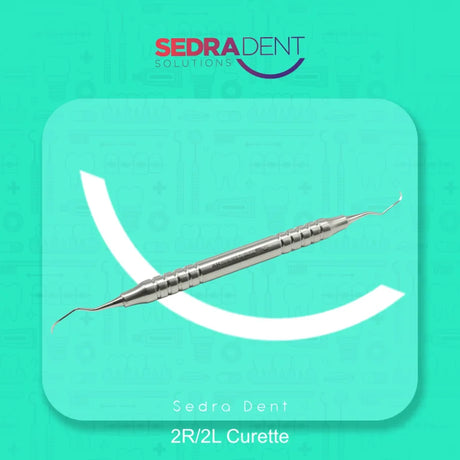
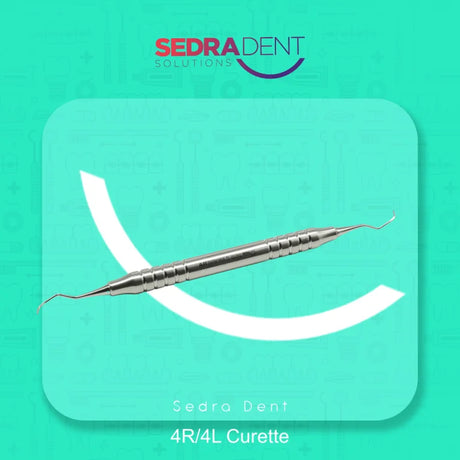


How to Choose the Right Periodontal Curette for Your Practice
- Gracey Area-Specific Design — Gracey curettes have one cutting edge per working end and offset blade angulation (approximately 70°) engineered for a specific tooth surface and root anatomy — #1/2 and #3/4 for anteriors, #5/6 for anteriors/premolars, #7/8 and #9/10 for facial/lingual posterior surfaces, #11/12 for mesial posterior surfaces, #13/14 for distal posterior surfaces. Selecting the correct Gracey number for the treated surface gives the instrument its adaptation advantage over a universal curette.
- Universal vs Area-Specific Blade Angulation — Universal curettes have two cutting edges per working end at a 90° blade-to-shank angle, letting one instrument scale multiple tooth surfaces without a full area-specific set — useful for general practices with lower periodontal caseload, though Gracey sets remain the standard for definitive root planing in specialist periodontal practice.
- Terminal Shank Length and Rigidity — Standard-shank curettes suit shallow-to-moderate pockets (up to 5mm); rigid or extended-shank variants (after-five, mini-five designs) reach deeper pockets and furcation areas without excessive flexing, which matters for removing tenacious, burnished calculus in moderate-to-advanced periodontitis.
- Steel Grade and Edge Retention — Curette blades are forged from martensitic stainless steel (comparable to AISI 420-series) and hardened for edge retention; higher-hardness steel holds a sharp cutting edge through more strokes before requiring a sharpening stone, reducing chairside resharpening frequency during a full-mouth scaling appointment.
- Single-Ended vs Double-Ended Configuration — Double-ended curettes pair two Gracey numbers (e.g. #11/12 and #13/14) on one handle, reducing instrument tray count and chairside instrument changes; single-ended designs offer better tactile balance for clinicians who prefer a dedicated instrument per working end.
- Handle Diameter and Weight — Lightweight, larger-diameter handles reduce hand fatigue and improve tactile sensitivity during extended scaling sessions — a meaningful ergonomic factor for Egyptian clinics running high daily patient volumes in periodontal maintenance recall.
Curette Types at a Glance
| Type | Blade Design | Primary Use |
|---|---|---|
| Gracey #1/2, #3/4 | Offset 70°, single cutting edge | Anterior teeth |
| Gracey #11/12, #13/14 | Offset 70°, single cutting edge | Mesial/distal posterior surfaces |
| Universal curette | 90° blade-to-shank, double cutting edge | General scaling, multiple surfaces |
| Jacquette curette-scaler | Pointed tip, sickle-style edge | Supragingival scaling with subgingival access |
Availability & Delivery in Egypt
MedSTA stocks Gracey area-specific sets and universal periodontal curettes from ASA Dental, Sedra dent, Accuram, and Premia, priced from approximately 390 EGP per instrument, with fast delivery to periodontal and general dental practices across Cairo, Giza, Alexandria, and all Egyptian governorates. Instruments are supplied non-sterile for in-clinic autoclaving; store in a dry instrument cassette to prevent corrosion in Egypt's humid coastal regions.
Frequently Asked Questions
What does the number on a Gracey curette (e.g. #11/12) actually mean?
What does the number on a Gracey curette (e.g. #11/12) actually mean?
The numbers identify the paired working ends on a double-ended Gracey curette and correspond to the tooth surface each end is angulated to treat — #11/12 is designed for mesial surfaces of posterior teeth, #13/14 for distal surfaces, #7/8 and #9/10 for facial and lingual posterior surfaces, and #1/2, #3/4 for anterior teeth. The number is not a size grade; it identifies surface-specific blade angulation.
How do I know when a curette needs sharpening during a scaling appointment?
How do I know when a curette needs sharpening during a scaling appointment?
A dull curette burnishes calculus rather than shaving it off, and produces a scratchy, chattering tactile sensation against the tooth surface instead of smooth, biting resistance. A quick visual test is running the blade edge against a plastic testing stick under good light — a dull edge reflects light as a visible white line, while a sharp edge shows no reflection. Sharpen with a fine-grit Arkansas or ceramic stone, maintaining the original 70° offset angle.
Can the same curette be used for both scaling and root planing?
Can the same curette be used for both scaling and root planing?
Yes, though the technique differs. Scaling uses shorter, overlapping strokes to remove supragingival and subgingival calculus deposits, while root planing uses longer, deliberate strokes with firmer lateral pressure to smooth cementum and remove residual endotoxin-contaminated tissue from the root surface. The same Gracey or universal curette performs both, but root planing typically requires a sharper edge and more strokes per site.
How many autoclave cycles can a periodontal curette withstand before replacement?
How many autoclave cycles can a periodontal curette withstand before replacement?
A well-maintained stainless steel curette can withstand several hundred autoclave cycles before the working edge degrades beyond effective sharpening, though repeated sharpening progressively thins the blade and changes its angulation. In Egyptian clinics running high daily throughput, inspect curettes monthly for pitting, discoloration, or a blade that no longer holds an edge after sharpening, and replace at that point rather than by a fixed cycle count.
Does MedSTA supply full Gracey curette sets across Egypt?
Does MedSTA supply full Gracey curette sets across Egypt?
Yes. MedSTA supplies individual Gracey curettes (#1/2 through #13/14), universal curettes, and combination Jacquette curette-scalers from ASA Dental, Sedra dent, Accuram, and Premia, with EGP pricing and fast delivery to dental clinics and periodontal practices throughout Egypt.