

GENERIC
In stock (91 units)Regular price LE 90.00 EGPUnit price /Unavailable-
 46% off
Guard
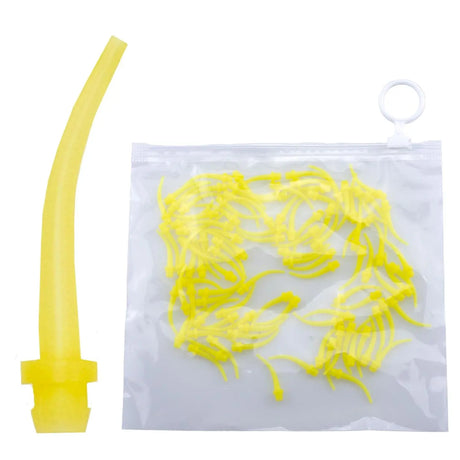
Guard Dent Intra Oral Tips Yellow
In stock (48 units)Sale price LE 89.00 EGP Regular price LE 165.00Unit price /UnavailableKULZER
Kulzer Intra-Oral Tips 96 tips
In stock (40 units)Regular price LE 2,100.00 EGPUnit price /Unavailable-

KULZER
Kulzer Bite Registration Tip 96 tips
Low stock (10 units)Regular price LE 2,250.00 EGPUnit price /Unavailable


How to Choose the Right Intraoral Tips for Your Practice
- Mixing Ratio Compatibility — Intraoral tips are color-coded to match the cartridge mixing ratio of the material dispensed — commonly yellow for 4:1 and blue for 1:1 automix systems used with bite registration and temporary cement cartridges. Using a tip rated for the wrong ratio produces an incompletely mixed, under-set material at the tooth surface.
- Tip Gauge and Length — A narrower bore and extended length improve access to posterior sextants and interproximal contacts without excess material extrusion, which matters most when placing bite registration silicone directly between opposing molars in a limited-opening patient.
- Connector Fit — Confirm the tip's luer-style connector matches the dispensing gun and cartridge system in use (Kulzer, generic universal fitting, or proprietary); a loose connection during intraoral dispensing risks material leaking into the sulcus or onto adjacent soft tissue.
- Single-Use vs. Designed-for-Single-Use — Intraoral tips are placed directly against oral tissue and should be treated as single-patient, single-use components even when the housing appears reusable, since internal mixing-element geometry cannot be reliably disinfected between patients.
- Material Compatibility — Confirm the tip is validated for the specific material class dispensed — VPS bite registration silicone, bis-acryl temporary crown and bridge material, or endodontic sealer — since internal mixing-element pitch is tuned to each material's viscosity and set time.
- Box Quantity for Clinic Volume — Higher-volume clinics benefit from 96-tip boxes to avoid mid-week stockouts, while lower-volume practices may prefer smaller counts to reduce shelf-life waste, since unopened tips have a defined shelf life once removed from sterile packaging.
Intraoral Tip Types at a Glance
| Type | Mixing Ratio | Primary Material | Typical Pack Size |
|---|---|---|---|
| Bite registration tip | 1:1 or 4:1 | VPS bite registration silicone | 96 tips |
| Standard intraoral mixing tip | 4:1 | Temporary cement, composite liner | 50–100 tips |
| Single mac tip | N/A (single-use nozzle) | Precision dispensing | Individual |
Availability & Delivery in Egypt
MedSTA supplies intraoral tips from Kulzer, Ultradent, and Guard Dent, priced in EGP with delivery across Cairo, Giza, Alexandria, and all Egyptian governorates. Stock in bulk 96-tip boxes to avoid running out mid-week in a high-patient-volume clinic.
Frequently Asked Questions
What is the difference between intraoral tips and standard impression mixing tips?
What is the difference between intraoral tips and standard impression mixing tips?
Intraoral tips are narrower and often longer than standard impression tray mixing tips, designed to dispense material directly at the treatment site inside the mouth — such as bite registration silicone between opposing arches or temporary cement into a prepared crown. Standard impression mixing tips are built for higher-volume flow into a tray held outside the mouth and are not sized for precise intraoral placement.
Are intraoral tips color-coded the same way as impression mixing tips?
Are intraoral tips color-coded the same way as impression mixing tips?
Yes, most intraoral tips follow the same industry-standard color convention as impression mixing tips — yellow typically indicates a 4:1 mixing ratio and blue indicates 1:1 — matched to the cartridge system in use. Always confirm the tip color matches the cartridge's stated ratio before dispensing, since a mismatched tip produces incompletely mixed material.
Can an intraoral tip be reused after autoclaving between patients?
Can an intraoral tip be reused after autoclaving between patients?
No. Intraoral tips contain an internal static-mixing element with fine geometry that cannot be reliably cleaned or disinfected once material has passed through it, and they contact oral tissue directly during use. They should be treated as single-patient, single-use components and discarded after each dispensing, regardless of housing material.
Why do intraoral tips matter for bite registration accuracy?
Why do intraoral tips matter for bite registration accuracy?
An intraoral tip with the correct bore and mixing ratio ensures VPS bite registration material is fully catalyzed by the time it reaches the occlusal surface, since the fixed-length internal mixing element only has so much material-contact time as the syringe is dispensed. A worn, wrong-ratio, or previously-used tip risks an unset or distorted registration that produces an inaccurate articulator mounting.
Does MedSTA supply intraoral tips with delivery across Egypt?
Does MedSTA supply intraoral tips with delivery across Egypt?
Yes, MedSTA supplies intraoral tips from Kulzer, Ultradent, and Guard Dent in various box sizes, priced in EGP with delivery to clinics across Cairo, Giza, Alexandria, and all Egyptian governorates.