

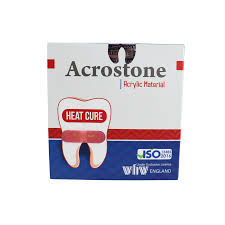
Acrostone
Low stock (9 units)Regular price LE 795.00 EGPUnit price /Unavailable
How to Choose the Right Heat Cure Acrylic Resin for Your Case
- Long-Cycle vs Short-Cycle (Boil-Out) Curing — a long cycle (approximately 74°C for 8–9 hours) produces lower residual monomer and better dimensional stability, while a short boil-out cycle (around 100°C for 20–30 minutes) saves laboratory time but carries a higher risk of porosity if not controlled precisely.
- Powder-to-Liquid Ratio — follow the manufacturer’s stated ratio exactly; excess monomer liquid increases polymerisation shrinkage and processing porosity, while too little liquid produces a dry, difficult-to-pack dough.
- Residual Monomer Content — a properly cured long-cycle resin typically retains well under 1% residual monomer, minimising the risk of mucosal irritation or allergic-type reactions in denture wearers.
- Flexural Strength (ISO 20795-1) — heat-cure PMMA should meet or exceed 65 MPa flexural strength; this benchmark supports long-term resistance to fracture under normal masticatory load.
- Porosity Control — internal (gaseous) porosity results from monomer boiling during rapid or excessive heating, while granular porosity results from insufficient packing pressure; a gradual, controlled curing cycle and adequate flask pressure address both.
- Shade Range — select from available pink denture-base shades to match patient gingival tone; most manufacturers offer a limited but sufficient range for routine complete and partial denture cases.
Heat Cure Acrylic Curing Cycles at a Glance
| Cycle | Temperature & Time | Residual Monomer | Best For |
|---|---|---|---|
| Long cycle | ~74°C for 8–9 hours | Lower | Definitive dentures, maximum dimensional accuracy |
| Short/boil-out cycle | ~100°C for 20–30 minutes | Higher if rushed | Faster turnaround, repairs |
Availability & Delivery in Egypt
MedSTA supplies Acrostone heat cure acrylic resin in EGP, with delivery to dental laboratories across Cairo, Giza, Alexandria, and all Egyptian governorates. Store powder and liquid components away from direct heat and sunlight, as Egypt’s summer temperatures can accelerate monomer evaporation once the liquid bottle is opened.
Frequently Asked Questions
Heat-cure vs self-cure/cold-cure acrylic — why prefer heat-cure for full dentures?
Heat-cure vs self-cure/cold-cure acrylic — why prefer heat-cure for full dentures?
Heat-cure acrylic is polymerised under controlled heat, which produces higher flexural strength and substantially lower residual monomer than a room-temperature self-cure system. These properties make heat-cure resin the standard choice for definitive full and partial dentures that must withstand years of daily function.
What causes porosity in heat-cured acrylic and how can it be avoided?
What causes porosity in heat-cured acrylic and how can it be avoided?
Internal gaseous porosity occurs when the monomer boils during rapid or excessive heating, while granular porosity results from insufficient packing pressure during flask closure. A gradual, controlled curing cycle combined with adequate flask pressure during packing addresses both causes.
Long curing cycle vs short boil-out cycle — which gives better strength?
Long curing cycle vs short boil-out cycle — which gives better strength?
A long curing cycle at approximately 74°C over eight to nine hours allows more complete polymerisation, resulting in lower residual monomer and generally better dimensional stability than a short boil-out cycle. The boil-out method saves laboratory time but requires precise temperature control to avoid porosity.
How does residual monomer affect patient comfort?
How does residual monomer affect patient comfort?
Higher residual monomer levels are associated with mucosal irritation and, in sensitised patients, allergic-type reactions to the denture-bearing tissue. A properly executed long-cycle cure minimises residual monomer and reduces this risk for the denture wearer.
Does MedSTA supply Acrostone heat cure acrylic across Egypt?
Does MedSTA supply Acrostone heat cure acrylic across Egypt?
Yes. MedSTA supplies Acrostone heat cure acrylic resin priced in EGP, with delivery to dental laboratories nationwide.