
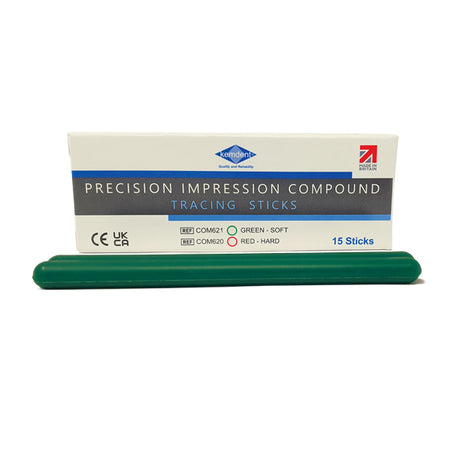
Kemdent
In stock (34 units)Regular price From LE 40.00 EGPUnit price /Unavailable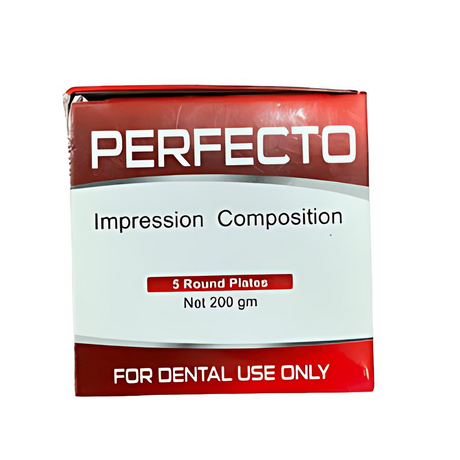
Dengen Dental
Low stock (13 units)Regular price LE 125.00 EGPUnit price /Unavailable
prevest Denpro
Prevest Hiflix green stick / box 10pc
Low stock (16 units)Regular price LE 313.00 EGPUnit price /Unavailable

How to Choose Impression Compound for Prosthodontic Procedures
- Softening temperature and working time — Impression compound softens at 55–65°C in a water bath and flows within 1–2 minutes of removal. It begins to set as it cools to below 45°C. In Egyptian summer conditions, the shorter temperature differential between the compound and ambient air reduces working time; working in an air-conditioned room and using slightly cooler water (55°C rather than 65°C) extends the useful flow window by approximately 30 seconds.
- Compound cake vs tracing sticks — Standard compound cakes (green or red) are used for primary (preliminary) impressions of edentulous ridges and for custom tray border moulding as a bulk thermoplastic mass. Green tracing sticks are narrower bars used specifically for border moulding of individual tray flanges in small increments, allowing sectional extension of the tray border rather than replacing the entire compound mass.
- Rigidity and dimensional stability — Set impression compound is rigid at room temperature and dimensionally stable for several hours, making it suitable as a primary impression material for complete denture prosthodontics. However, it cannot record fine surface detail at the dentinal or mucosal level; it is always used as a primary impression to create a custom tray for subsequent wash impressions in zinc oxide paste or light-bodied PVS.
- Tray material compatibility — Compound adheres to metal stock trays, which must be preheated in the water bath alongside the compound to prevent rapid chilling of the material on tray contact. Metal tray perforations improve compound retention within the tray during the impression. Plastic trays are less suitable as compound cools unevenly on contact with the non-conductive plastic surface.
- Green vs red compound — Green compound (lower softening temperature, approx. 55°C) is the standard for primary impressions and border moulding. Red compound (higher softening temperature, approx. 60–65°C) is harder at room temperature and is used for making impression trays where the compound forms the tray body itself rather than as an impression material.
Impression Compound Products at a Glance
| Product | Type | Softening Temp | Best For |
|---|---|---|---|
| Perfecto Impression Compound | Standard cake | 55–60°C | Primary complete denture impression |
| Perfecto Green Tracing Sticks | Border moulding sticks | 55°C | Sectional tray border extension |
| Kemdent Compound Green Sticks | Border moulding sticks | 55°C | Sectional tray border extension, anterior flange |
Availability & Delivery in Egypt
MedSTA stocks impression compound cakes and tracing sticks priced in EGP. Delivery covers Cairo and Giza within 24–48 hours and all other Egyptian governorates within 3–5 working days. Store compound at 15–25°C away from heat sources — prolonged storage above 30°C (common in Egyptian summers) causes partial softening and flow deformation of compound sticks in their packaging.
Frequently Asked Questions
What water temperature should be used to soften impression compound?
What water temperature should be used to soften impression compound?
Green impression compound (standard for primary impressions and border moulding) softens adequately in a water bath at 55–60°C. Red compound (higher melting point) requires 60–65°C. Do not exceed 65°C, as excessive heat causes partial degradation of the resin binder and discolouration. In Egyptian clinics during summer, where ambient temperatures often exceed 30°C, the water bath cools faster; replenish with hot water to maintain the 55–60°C range throughout the softening and loading process. Allow the compound to reach a uniform dough consistency before loading the tray — uneven softening causes voids in the impression.
How does green tracing stick compound differ from standard impression compound cake?
How does green tracing stick compound differ from standard impression compound cake?
Green tracing sticks and standard compound cake are both thermoplastic at the same temperature range (55–60°C) but differ in physical form and clinical use. Compound cake is a large rectangular block used to fill the entire impression tray for a primary full-arch impression of an edentulous ridge. Green tracing sticks are thin cylindrical rods that soften into a small, workable mass of compound — they are used to extend or correct the border of a custom tray in small increments during functional border moulding, without replacing the entire tray load. Tracing sticks allow precise sectional adjustment that would be impractical with a full compound cake.
Can impression compound be reused for a second impression?
Can impression compound be reused for a second impression?
Impression compound can be resoftened and reused on the same patient in the same appointment if the initial impression was unsatisfactory — resoften it fully to 55–60°C until it returns to a dough consistency, reload, and re-seat. However, compound must not be reused between patients as it is a mucosal-contact material and cross-infection is a risk even after surface disinfection. Additionally, repeated softening cycles degrade the plasticiser content over time, increasing brittleness and reducing flow — if compound becomes grainy or breaks during insertion, discard and use a fresh piece.
How does Egyptian summer heat affect impression compound storage and performance?
How does Egyptian summer heat affect impression compound storage and performance?
Impression compound stored above 30°C — common in non-air-conditioned Egyptian dental supply rooms during summer — may undergo partial softening, causing cakes and sticks to deform, fuse together, or develop surface tack. Deformed compound is difficult to load evenly into the tray and may introduce air voids at the tray-compound interface. Store impression compound in an air-conditioned room or insulated cabinet at 15–25°C. If compound has deformed but not degraded (no colour change, still homogeneous), it can often be reshaped in cool water before clinical use without loss of performance.
When should impression compound be used instead of alginate or PVS for a dental impression?
When should impression compound be used instead of alginate or PVS for a dental impression?
Impression compound is indicated as a primary impression material for complete edentulous impressions where the goal is only to record the approximate ridge form for making a custom tray — detail accuracy is not required at this stage. Alginate is preferred for dentate or partially dentate study models where surface detail is needed. PVS (polyvinylsiloxane) is used for final impressions where dimensional accuracy for crown/bridge or implant restorations is critical. Compound is not suitable as a final impression material for any restoration requiring accurate marginal fit, as it cannot reproduce dentinal or mucosal surface detail at the micro level.