

GENERIC
In stock (37 units)Regular price LE 17.00 EGPUnit price /Unavailable
How to Choose the Right Instrument Cleaning Brushes for Your Practice
- Manual Pre-Cleaning Before Ultrasonic Processing — visible bioburden such as dried cement or debris must be manually brushed away before ultrasonic cleaning, since an ultrasonic bath alone is far less effective at removing heavy surface deposits.
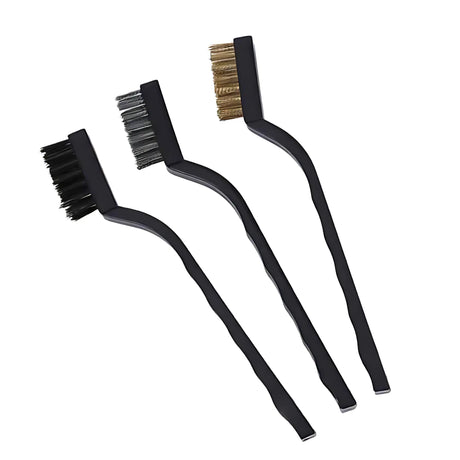
- Nylon vs Stainless Steel Bristles — nylon bristles are gentle enough for delicate or coated instrument surfaces, while stiffer stainless-steel bristles remove more stubborn dried debris from robust stainless-steel hand instruments without damaging them.
- Reusability and Sterilisation — select brushes rated for repeated autoclaving if your protocol requires reprocessing the brush itself between uses, rather than treating it as single-use.
- Brush Shape for Lumened Instruments — tapered, narrow-profile brushes are needed to reach inside handpiece channels and suction tubing lumens, which flat general-purpose brushes cannot clean effectively.
- Sequence Within the Spaulding Classification Workflow — manual brushing falls under the cleaning step that must precede disinfection or sterilisation for all instrument categories, regardless of whether the instrument is critical, semi-critical, or non-critical.
- Handle Ergonomics — a comfortable, non-slip handle reduces operator hand fatigue during high-volume end-of-day instrument reprocessing in a busy Egyptian clinic.
Instrument Cleaning Brush Types at a Glance
| Bristle Type | Best For | Reusable |
|---|---|---|
| Nylon, soft | Coated or delicate instrument surfaces | Yes, autoclavable options available |
| Nylon, stiff | General stainless-steel instruments | Yes, autoclavable options available |
| Tapered/narrow | Handpiece channels, suction lumens | Yes, autoclavable options available |
Availability & Delivery in Egypt
MedSTA supplies instrument cleaning brushes in EGP, with delivery to dental clinics and laboratories across Cairo, Giza, Alexandria, and all Egyptian governorates.
Frequently Asked Questions
Why is manual brushing still necessary if I have an ultrasonic cleaner?
Why is manual brushing still necessary if I have an ultrasonic cleaner?
Ultrasonic cleaning is effective at dislodging fine debris from crevices, but it is not a substitute for removing visible, dried-on bioburden first. Manual brushing before the ultrasonic cycle ensures heavier deposits are cleared so the ultrasonic bath can work effectively on the remaining fine debris.
Nylon vs stainless steel bristle brushes — which should I use?
Nylon vs stainless steel bristle brushes — which should I use?
Nylon bristles are gentle enough for coated or delicate instrument surfaces without scratching them, while stiffer stainless-steel bristles are better suited to removing stubborn dried debris from robust stainless-steel hand instruments.
Can instrument cleaning brushes be autoclaved and reused, or are they single-use?
Can instrument cleaning brushes be autoclaved and reused, or are they single-use?
Many instrument cleaning brushes are designed to withstand repeated autoclaving and can be reused as part of a clinic's standard reprocessing protocol, though brushes showing bristle damage or bending should be replaced promptly to maintain cleaning effectiveness.
What brush size is needed for cleaning handpiece and suction tubing lumens?
What brush size is needed for cleaning handpiece and suction tubing lumens?
Handpiece channels and suction tubing require a tapered, narrow-profile brush specifically designed to reach inside the lumen, since flat general-purpose instrument brushes cannot access these internal surfaces.
Does MedSTA supply instrument cleaning brushes across Egypt?
Does MedSTA supply instrument cleaning brushes across Egypt?
Yes. MedSTA supplies instrument cleaning brushes priced in EGP, with delivery to dental clinics and laboratories nationwide.