

Bio Strong
Very low stock (4 units)Regular price LE 4,800.00 EGPUnit price /Unavailable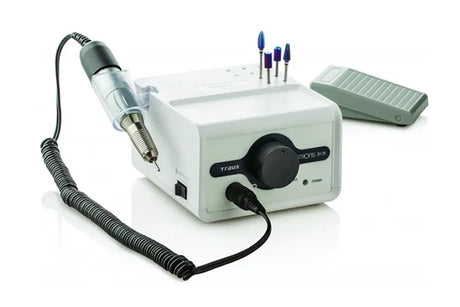
Saeshin
Strong Micromotor + contra B135
Very low stock (4 units)Regular price LE 8,550.00 EGPUnit price /Unavailable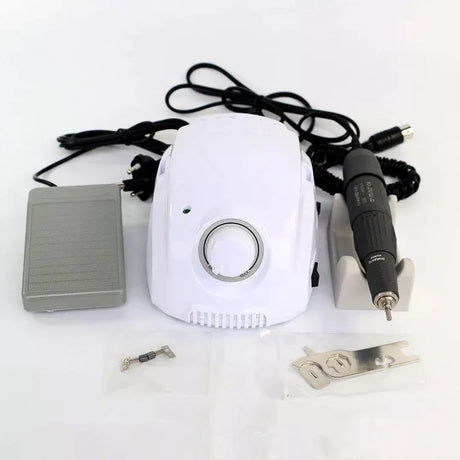
GENERIC
Very low stock (2 units)Regular price LE 5,500.00 EGPUnit price /Unavailable
Saeshin
Strong Micromotor 204 and Handpiece
Very low stock (2 units)Regular price LE 9,450.00 EGPUnit price /Unavailable


How to Choose the Right Dental Lab Micromotor for Your Laboratory
- Speed Range (1,000–40,000 RPM) — Variable-speed electric motor control allows infinitely adjustable RPM across the full range. Acrylic trimming typically requires 10,000–20,000 RPM; ceramic grinding 15,000–35,000 RPM; polishing 3,000–8,000 RPM. Confirm the control unit provides smooth ramp-up without torque spikes.
- Motor Torque Rating (Ncm) — Higher torque (≥4 Ncm at mid-range speed) maintains RPM under the load of acrylic and metal grinding. Budget units with low torque (<2 Ncm) lose speed during contact, producing uneven surfaces on restorations.
- Brushless vs Brushed Motor — Brushless motors (e.g. Saeshin Strong series) reduce maintenance requirements, extend service life beyond 5,000 hours, and generate less heat during prolonged laboratory sessions. Brushed motors require periodic carbon brush replacement but have a lower initial cost.
- Gear Ratio of Paired Contra-Angle — 1:1 ratio for direct-drive polishing; 1:4 increasing ratio for high-speed grinding applications; 4:1 decreasing ratio for precise low-speed finishing. Confirm the handpiece ratio matches the intended procedure before ordering a unit set.
- Forward/Reverse Function — Essential for releasing threaded bur systems without damaging the contra-angle chuck. Confirm the control unit supports directional switching without a full stop cycle.
- Autoclave Compatibility of Handpiece — The paired contra-angle or straight handpiece must endure Class B autoclave cycles (134°C, 3 bar) when used clinically. Lab-only units may use non-autoclavable handpieces; verify intended use before purchase.
Dental Lab Micromotor Comparison
| Model | Speed Range | Motor Type | Price (EGP) |
|---|---|---|---|
| MAC Micromotor & Handpiece | Up to 35,000 RPM | Brushed | 4,500 |
| Saeshin Strong 204 | Up to 40,000 RPM | Brushless | 9,450 |
| Saeshin Strong B135 | Up to 35,000 RPM | Brushless | 9,450 |
| GENERIC Micromotor Set | Up to 30,000 RPM | Brushed | 5,500 |
Availability & Delivery in Egypt
MedSTA supplies dental lab micromotors from Saeshin (Strong 204 and B135 series) and MAC, all priced in EGP with same-day dispatch from Cairo. Delivery to Cairo and Giza within 1–3 business days; all other Egyptian governorates within 3–5 business days. Contact MedSTA for institutional pricing for Egyptian dental laboratory groups.
Frequently Asked Questions
What is the difference between a brushless and a brushed dental lab micromotor?
What is the difference between a brushless and a brushed dental lab micromotor?
Brushless micromotors (e.g. Saeshin Strong series) use electronic commutation rather than physical carbon brushes, resulting in longer service life (5,000+ hours vs 1,000–2,000 hours), lower heat generation during extended laboratory sessions, and consistent torque delivery across the full RPM range. Brushed motors require periodic carbon brush replacement every 800–1,500 hours of use but have a lower initial cost, making them suitable for lower-volume Egyptian dental laboratories.
What RPM is required for acrylic finishing versus ceramic trimming in a dental laboratory?
What RPM is required for acrylic finishing versus ceramic trimming in a dental laboratory?
Acrylic resin finishing requires 10,000–20,000 RPM with a tungsten carbide or acrylic bur to avoid surface melting and smearing. Ceramic trimming and adjustment of porcelain restorations requires 15,000–35,000 RPM with diamond-coated or sintered burs under water coolant. Polishing acrylic or resin bases is best performed at 3,000–8,000 RPM with a felt or silicone polishing attachment to develop surface gloss without generating excess heat.
Can Saeshin Strong micromotor handpieces be used with Egyptian-manufactured burs?
Can Saeshin Strong micromotor handpieces be used with Egyptian-manufactured burs?
Yes — Saeshin Strong contra-angle handpieces use a standard ISO 2.35 mm latch-type chuck that is compatible with any RA-shank bur meeting ISO 1797-1 specifications, including Egyptian and regional bur brands. Straight handpieces use a standard HP-shank (2.35 mm) chuck. Confirm the bur shank diameter tolerance is within ±0.02 mm to prevent chuck wear and bur wobble during high-speed grinding.
How should dental lab micromotors be stored during Egyptian summer to prevent motor damage?
How should dental lab micromotors be stored during Egyptian summer to prevent motor damage?
Store the control unit and handpieces in a dry environment away from direct sunlight. In Egyptian summer (ambient temperatures of 35–45°C without climate control), excessive heat accelerates bearing grease degradation and motor winding insulation deterioration. Store units in a climate-controlled laboratory room or in a closed cabinet when not in use. Clean handpiece chucks weekly to remove acrylic and metal debris that can cause bearing seizure during high-temperature operation.
Does MedSTA supply Saeshin and MAC dental lab micromotors across Egypt?
Does MedSTA supply Saeshin and MAC dental lab micromotors across Egypt?
Yes — MedSTA supplies Saeshin Strong 204, Strong B135, and MAC micromotor units in EGP with same-day dispatch from Cairo. Cairo and Giza delivery within 1–3 business days; all other Egyptian governorates within 3–5 business days. Institutional pricing is available for Egyptian dental laboratory groups and dental faculties.