
 12% off
Voco
Very low stock (5 units)Sale price LE 185.00 EGP Regular price LE 210.00Unit price /Unavailable
DMG
DMG Retraction Paste - 1 Capsule 0,37 g
Low stock (10 units)Regular price LE 275.00 EGPUnit price /Unavailable

How to Choose Retraction Paste for Your Prosthetic Workflow
- Active astringent concentration — Standard retraction pastes use 25% aluminium chloride (AlCl₃), which achieves reliable tissue displacement and haemostasis without the extreme pH of ferric sulphate solutions. At this concentration, AlCl₃ is compatible with PVS and VPES impression materials after thorough rinsing.
- Carrier base viscosity — Kaolin or clay-based carriers give the paste sufficient body to remain within the sulcus under gentle syringe pressure without spreading onto the tooth surface. Look for a viscosity that flows under light hand pressure but does not run beyond the gingival margin.
- Working time in Egyptian clinic conditions — Standard clinical contact time is 60–120 seconds. In Egyptian summer conditions (clinic temperatures often 30–40°C), tissue fluid production increases; a longer working time (90–120 s) is preferable before impression taking.
- Rinsing protocol and impression material compatibility — After working time, the sulcus must be fully irrigated with air-water spray to remove all AlCl₃ residue. Inadequate rinsing inhibits addition-silicone VPS materials, producing a tacky, detail-poor impression surface. Polyether materials (e.g. Impregum) tolerate residual AlCl₃ better.
- Syringe format and tip gauge — Single-use 0.3 g syringe caps (e.g. Voco) offer precise sulcular delivery. Multi-unit starter packs (e.g. Kulzer Retraxil) suit high-volume prosthetic clinics. A narrow-gauge tip (approx. 23G) allows sulcular entry without tissue blanching from excess pressure.
Retraction Paste Products at a Glance
| Product | Active Agent | Format | Best For |
|---|---|---|---|
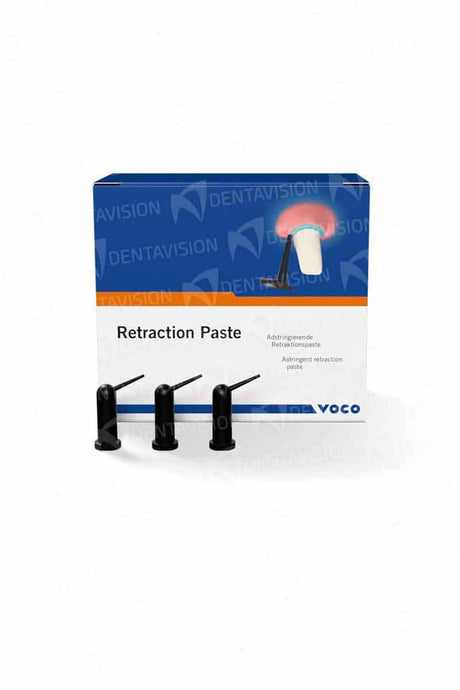
| Voco Retraction Paste 0.3 gm | 25% AlCl₃ + kaolin | Unit-dose syringe cap | Single-tooth preparations, minimal bleeding |
| Kulzer Retraxil Starter Pack 1g | Astringent paste | Multi-unit syringe pack | High-volume prosthetic clinic, full-arch cases |
Availability & Delivery in Egypt
MedSTA stocks syringe-format retraction pastes priced in EGP. Delivery covers Cairo and Giza within 24–48 hours and all other Egyptian governorates within 3–5 working days. Store retraction paste at 15–25°C away from direct sunlight — particularly important in Egyptian summer when ambient temperatures routinely exceed 30°C and can reduce shelf life and alter paste syringeability.
Frequently Asked Questions
How does retraction paste differ from retraction cord for gingival displacement?
How does retraction paste differ from retraction cord for gingival displacement?
Retraction paste — typically 25% aluminium chloride in a kaolin carrier — works by osmotic and astringent action, contracting sulcular tissue and controlling bleeding without mechanical cord compression. Cord packing applies direct physical pressure, which can cause ischaemic injury in thin gingival biotypes. Paste is applied via syringe in 60–120 seconds and eliminates the risk of leaving cord remnants subgingivally. Many clinicians combine a thin retraction cord (size 000 or 00) with paste for optimal retraction in deeper sulci.
Can retraction paste inhibit PVS impression materials?
Can retraction paste inhibit PVS impression materials?
Yes — aluminium chloride residue inhibits addition-silicone (PVS/VPES) impression materials, producing a tacky, detail-poor set surface. After the working time (60–120 s), the sulcus must be fully irrigated with air-water spray and gently dried before impression taking. Polyether materials (e.g. Impregum) are more tolerant of residual AlCl₃. A white kaolin residue line in the sulcus indicates incomplete rinsing and requires further irrigation.
What is the correct technique for applying retraction paste subgingivally?
What is the correct technique for applying retraction paste subgingivally?
Load a narrow-gauge tip (approx. 23G) against the gingival margin and express paste gently into the sulcus under steady low pressure, tracing circumferentially around the preparation. Avoid high injection pressure, which can tear junctional epithelium. Leave undisturbed for 60–120 seconds — use the longer contact time in Egyptian summer months when increased tissue perfusion is common — then irrigate thoroughly with air-water spray until the sulcus is visually clear before proceeding.
When is retraction paste not sufficient and cord must be used instead?
When is retraction paste not sufficient and cord must be used instead?
Retraction paste alone is insufficient when the preparation margin extends more than 0.5 mm below the gingival crest, when there is active uncontrolled bleeding from periodontal disease, or when sulcus depth is less than 1 mm. In these cases, a double-cord technique or electrosurgical retraction is more reliable. Retraction paste is best indicated for supragingival to just-subgingival margins in patients with healthy, non-inflamed gingival tissue.
How should retraction paste be stored in Egyptian dental clinics?
How should retraction paste be stored in Egyptian dental clinics?
Store retraction paste at 15–25°C in a cool, shaded location — not in the refrigerator, which can cause phase separation in kaolin-based formulations. In Egyptian summer conditions, where clinical room temperatures can reach 35–40°C, store paste in an air-conditioned supply cabinet away from external walls exposed to direct sun. Heat thickens the carrier and reduces syringeability. Check the expiry date on each syringe unit before use.