

GENERIC
Low stock (20 units)Regular price LE 20.00 EGPUnit price /Unavailable-

GENERIC
Very low stock (6 units)Regular price LE 75.00 EGPUnit price /Unavailable
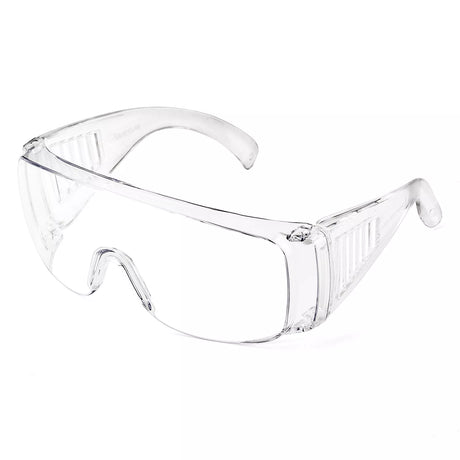


How to Choose the Right Dental Safety Glasses for Your Practice
- EN 166 Optical Impact Compliance — Dental safety glasses used for clinician ocular protection must conform to EN 166 (Personal eye protection, specifications) and EN 170 or EN 172 for UV or solar protection ratings respectively. The lens must meet F-rated impact resistance (low-energy impact, 6mm steel ball at 45 m/s) at minimum. Do not use fashion eyewear or non-rated frames as clinical eye protection; they provide no certified ballistic or splash resistance.
- Wrap-Around Frame Design — A wrap-around frame that curves to cover the temporal zones provides superior lateral splash and aerosol protection compared to flat-front standard spectacle frames. Dental aerosol generated by high-speed handpieces and ultrasonic scalers disperses at angles of 45–90° from the tooth surface — straight-fronted glasses leave the lateral eye area unprotected. Full-wrap or semi-wrap lens designs are the correct choice for chairside eye protection in all operative dental procedures.
- Anti-Fog Lens Coating — Fogging of safety glasses is a common usability problem in Egyptian dental clinics where the temperature differential between the air-conditioned clinical environment and warm dental aerosol is significant. Anti-fog-coated lenses (hydrophilic surface treatment) maintain clear vision during continuous operative sessions. Verify the anti-fog coating is on the inner lens surface, as fogging originates from warm air between the face and the lens.
- UV Protection Rating — Dental curing lights (LED, 385–515nm blue light range) and certain diagnostic lasers can cause retinal and corneal photokeratitis with prolonged direct exposure. Safety glasses with blue-light blocking or UV-protective lenses (orange- or amber-tinted) are recommended during light-curing procedures. Clear lenses provide no blue-light protection; use tinted or orange-lensed safety glasses when operating curing lights at close range.
- Autoclavable Frames vs. Disposable Glasses — High-quality safety glasses with polycarbonate or nylon frames can be autoclaved at 121°C (gravity cycle) for sterilisation between patients. Autoclavable frames survive 50–100 cycles before hinge and lens-retention fatigue. Disposable protective glasses (lower-cost acrylic or polystyrene) cannot be autoclaved but can be disinfected with alcohol wipe between patients; they are not true single-use items but should be replaced after 1–5 uses as lens clarity degrades.
- Patient vs. Clinician Models — Patient safety glasses (wider, over-frame designs) are larger to fit over prescription spectacles and provide adequate front protection for a reclining patient. Clinician safety glasses (closer-fitting, wrap-around) provide the tighter fit and lateral coverage required for an operating dental professional. Stocking both patient (10–20 pairs, reusable with disinfection) and clinician models is the complete infection control protocol for eye protection in an Egyptian dental practice.
Dental Safety Glasses Types at a Glance
| Feature | Clinician Safety Glasses | Patient Protective Glasses |
|---|---|---|
| Frame design | Wrap-around, close-fitting | Over-frame, wider fit |
| EN 166 rated | Yes (clinical standard) | Recommended |
| Anti-fog coating | Available | Optional |
| UV/blue-light blocking | Available (orange lens) | Basic tint only |
| Sterilisation | Autoclavable (121°C) | Alcohol wipe / limited autoclave |
Availability & Delivery in Egypt
MedSTA stocks dental safety glasses in clear and tinted lens formats, in clinician and patient models, priced in EGP with delivery across Cairo, Giza, Alexandria, and all Egyptian governorates within 1–3 business days. Available individually or in multi-pack quantities for stocking clinical rooms in Egyptian dental hospitals, private practices, and university clinics.
Frequently Asked Questions
Should dental patients as well as clinicians wear safety glasses during procedures?
Should dental patients as well as clinicians wear safety glasses during procedures?
Yes — patient ocular protection during dental procedures is as important as clinician protection. Patients are at risk from: high-speed drill debris fragments, aerosol splatter from irrigation and handpiece cooling water, dental material particles (composite, impression material), and accidental instrument contact during transfer. The patient lies in a supine position with eyes directed upward toward the operating field, making them particularly vulnerable to splatter and flying debris. A disposable or clinic-provided protective glass is standard practice in evidence-based infection control protocols and is increasingly required by Egyptian dental regulatory standards.
What does EN 166 mean for dental safety glasses, and why does it matter?
What does EN 166 mean for dental safety glasses, and why does it matter?
EN 166 is the European standard for personal eye protection that specifies performance requirements for impact resistance, optical quality, and field of vision. Glasses conforming to EN 166 have been tested with a 6mm steel ball at 45 m/s (F-rated, minimum impact class) and confirmed to withstand the energy levels generated by dental instrument fragments, bur pieces, or dislodged calculus during scaling. Fashion spectacles, sunglasses, and non-rated protective eyewear have not been tested to these criteria and may shatter or fail under dental procedure impact loads. Always confirm EN 166 compliance when selecting clinical eye protection in Egypt.
Can dental safety glasses be autoclaved and reused between patients?
Can dental safety glasses be autoclaved and reused between patients?
High-quality safety glasses with polycarbonate or nylon frames can be autoclaved at 121°C in a gravity cycle for sterilisation between patients, surviving approximately 50–100 autoclave cycles before hinge and lens-retention mechanisms fatigue. For clinics where autoclaving every glass between patients is not practical, thoroughly disinfect with an EN 14885-compliant surface disinfectant wipe (alcohol-based), pay particular attention to the nose pad and frame areas in contact with the patient’s skin, and confirm the lens surface is fully dried before use. Lower-grade acrylic or polystyrene glasses cannot withstand autoclave temperatures and require chemical disinfection.
What is the difference between safety glasses and a face shield for dental eye protection?
What is the difference between safety glasses and a face shield for dental eye protection?
Dental safety glasses provide EN 166-rated impact and splash protection for the eyes only, with a frame that fits to the face. They are compact, lightweight, and suitable for routine operative procedures. A dental face shield covers the entire face (eyes, nose, mouth, chin) and provides significantly greater surface area protection against aerosol and splatter contamination, but is bulkier and may interfere with the clinician’s working position at close range. For standard restorative and examination procedures, safety glasses with wrap-around frames are adequate. For high-aerosol procedures (ultrasonic scaling, high-speed drilling for 30+ minutes), a face shield provides superior protection; glasses are worn under the face shield in that scenario.
How should dental safety glasses be cleaned and disinfected between patients in Egypt?
How should dental safety glasses be cleaned and disinfected between patients in Egypt?
After each patient contact, remove the glasses by the frame (not the lenses), wipe both the inner and outer lens surfaces and the frame with an EN 14885-compliant alcohol wipe (70% isopropanol) and allow to air-dry for 30 seconds. Pay particular attention to the nose bridge, temple arms, and any surface that contacted patient skin, which are the highest-contamination zones. Do not use concentrated chlorine-based disinfectants on polycarbonate lenses — repeated bleach exposure yellows the lens and degrades optical clarity. In Egyptian clinics where ambient humidity causes lenses to fog after disinfection, buff dry with a clean lint-free cloth before presenting to the next patient.