
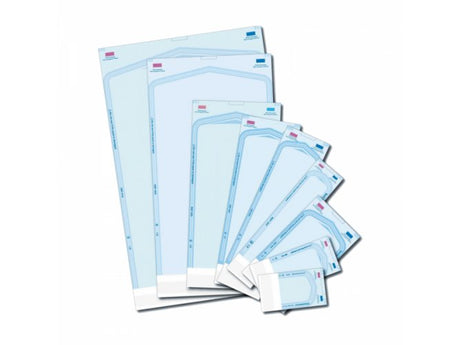
GENERIC
In stock (32 units)Regular price From LE 95.00 EGPUnit price /Unavailable
How to Choose Sterilisation Pouches for Your Dental Clinic
- Self-sealing vs heat-seal pouches — Self-sealing pouches (peel-off adhesive strip) eliminate the need for a heat-sealing machine and are preferred in smaller clinics. Heat-seal pouches require a validated sealing device but produce a stronger, tamper-evident seam suitable for heavier cassette or handpiece loads. Both types must maintain a sterility barrier through the autoclave cycle and during storage.
- Process indicators (Class 4 vs Class 6) — All pouches carry at least a Class 4 multi-variable indicator that changes colour when exposed to steam, temperature, and time. Class 6 emulating indicators confirm that all three critical parameters (temperature, time, and steam) met the required autoclave cycle values — Class 6 is the preferred standard for instrument traceability in Egyptian dental hospitals and clinics serving multiple operators.
- Paper/plastic composite construction — Pouches use a one-side paper (allows steam penetration and indicator visibility) and one-side transparent plastic (allows visual inspection of contents post-sterilisation). Ensure the paper layer is medical-grade (EN 868-5 compliant) to prevent microbial ingress during storage.
- Size selection by instrument type — Match pouch width to the widest instrument: 60×100 mm for mirrors and probes, 75×130 mm for extraction forceps and elevators, 90×230 mm for handpieces. Overfilling a pouch breaks the seal; undersizing bunches the paper and prevents adequate steam circulation around instruments.
- Sterility maintenance after autoclaving — Sealed pouches maintain sterility for 1 month (open shelving) to 12 months (closed cupboard, cool, dry conditions) per EN ISO 11607. In Egyptian summer humidity conditions, store autoclaved pouches in closed, air-conditioned storage to achieve the full 12-month shelf life.
Sterilisation Pouch Products at a Glance
| Product | Seal Type | Indicator | Best For |
|---|---|---|---|
| Generic Sterilisation Pouches | Self-sealing adhesive | Class 4 | Individual instruments, cost-efficient daily use |
| AL ABD Sterilization Pouches 19 cm | Heat-seal | Class 4/6 | Larger instruments, cassette packaging |
Availability & Delivery in Egypt
MedSTA stocks sterilisation pouches in multiple sizes priced in EGP. Delivery covers Cairo and Giza within 24–48 hours and all other Egyptian governorates within 3–5 working days. Store unopened pouches in a clean, dry area at 15–25°C — Egyptian summer humidity above 60% RH can compromise the adhesive on self-sealing strips before use, reducing seal strength in the autoclave cycle.
Frequently Asked Questions
What do Class 4 and Class 6 process indicators on sterilisation pouches mean?
What do Class 4 and Class 6 process indicators on sterilisation pouches mean?
Class 4 multi-variable indicators (the printed ink strip on the outside of most standard pouches) change colour when exposed to two or more of the critical sterilisation parameters — steam, temperature, and time. They confirm the pouch was exposed to the autoclave cycle but do not confirm that all parameters met their required values. Class 6 emulating indicators go further: they change colour only when temperature, time, and steam saturation all meet the specific requirements for the chosen cycle (e.g. 134°C for 3.5 minutes in a Class B autoclave). Class 6 is the preferred standard for regulated dental practices and hospital-grade infection control in Egypt.
Can sterilisation pouches be reused after autoclaving?
Can sterilisation pouches be reused after autoclaving?
No — sterilisation pouches are single-use items. Once an autoclaved pouch is opened at chairside, both the instrument and the packaging are contaminated and must be discarded or the instrument reprocessed. The paper layer's porous structure that allowed steam penetration during autoclaving also means it cannot function as a sterility barrier after opening. Re-sealing a used pouch is not permitted under any EN ISO 11607 or WHO infection control guideline, as the previous cycle's residual moisture and microbial load cannot be guaranteed to have been eliminated on reprocessing.
How should autoclaved instrument pouches be stored in Egyptian dental clinics?
How should autoclaved instrument pouches be stored in Egyptian dental clinics?
Store autoclaved, sealed pouches in a closed, clean cupboard away from direct sunlight and water sources. In Egyptian summer conditions — where ambient humidity often exceeds 60–70% RH — store pouches in an air-conditioned room or humidity-controlled cabinet. Moisture ingress through the paper layer is the most common cause of sterility barrier failure during storage; pouches that feel damp, show water stains, or have compromised seals must be reprocessed. Under ideal storage conditions (closed cupboard, 15–25°C, below 60% RH), sealed pouches maintain sterility for up to 12 months per EN ISO 11607.
What size sterilisation pouch should I use for different dental instruments?
What size sterilisation pouch should I use for different dental instruments?
Select the pouch width so that the instrument fits without folding or forcing: 60×100 mm suits dental mirrors, probes, and explorers; 75×130 mm fits elevators, scalers, and extraction forceps; 90×230 mm accommodates handpieces and larger surgical instruments. Pouches should be no more than 3/4 full to allow adequate steam circulation inside. Overfilling a pouch prevents full steam contact with all instrument surfaces and can compromise the adhesive or heat seal. MedSTA stocks multiple sizes of sterilisation pouches to cover the full instrument range in an Egyptian dental clinic.
How long do sterilisation pouches maintain sterility after autoclaving?
How long do sterilisation pouches maintain sterility after autoclaving?
Sterility maintenance depends on storage conditions, not just the autoclave cycle. Under ideal closed-cupboard conditions (15–25°C, below 60% RH), paper/plastic sterilisation pouches maintain sterility for 6–12 months. On open shelving at room temperature, the sterility maintenance period is typically reduced to 1 month. In Egyptian clinic environments with summer temperatures above 30°C and high humidity, closed, air-conditioned storage is essential to approach the 12-month end date. Always inspect the indicator, seal integrity, and pouch condition before use regardless of the storage date.