
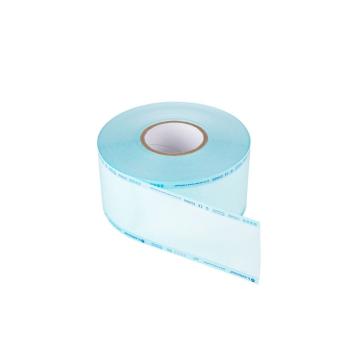
GENERIC
Very low stock (7 units)Regular price From LE 199.00 EGPUnit price /Unavailable
How to Choose Sterilisation Rolls for Your Dental Clinic
- Reel width selection — Sterilisation rolls are available in widths from 50 mm to 300 mm. Select the reel width that accommodates your largest regularly packaged instrument category without requiring folding. Common sizes: 75 mm for hand instruments (scalers, curettes), 100 mm for cassettes, 150–200 mm for large surgical cassettes or bulky items.
- Heat-sealing temperature and machine calibration — Sterilisation rolls require a heat-sealing machine to close each cut end. The sealer must be calibrated to 160–200°C (per the roll manufacturer's specification) to produce a hermetic seal. Undersetting the sealer produces a weak or non-fused seal that fails during autoclaving; oversetting burns the paper layer and compromises the sterility barrier. Validate the sealer temperature with a calibrated thermometer strip at least monthly.
- Cutting length and minimum sealed length — Cut each roll section at least 5 cm longer than the instrument to allow adequate sealed margins at both ends. Both the top and bottom seals must be at least 10 mm wide. Inadequate sealed margins are the most common cause of sterility barrier failure during the autoclave cycle or subsequent storage in Egyptian clinic environments.
- Class 4 process indicator on the paper face — Like pre-formed pouches, sterilisation rolls incorporate a Class 4 multi-variable indicator strip printed on the paper side. Confirm the indicator has changed to the pass colour after every autoclave cycle before placing the packaged instrument in sterile storage.
- Paper/plastic composite and steam penetration — The paper side must face inward for steam to penetrate and make contact with the instrument. Placing the instrument with the plastic side facing inward blocks steam access and compromises sterilisation efficacy regardless of autoclave cycle parameters.
Sterilisation Roll Products at a Glance
| Product | Width | Seal Type | Best For |
|---|---|---|---|
| Generic Sterilization Roll | Multiple widths available | Heat-seal ends (machine required) | Custom-length packaging for all instrument sizes |
Availability & Delivery in Egypt
MedSTA stocks sterilisation rolls in multiple widths priced in EGP. Delivery covers Cairo and Giza within 24–48 hours and all other Egyptian governorates within 3–5 working days. Store roll reels in their original packaging in a cool, dry location at 15–25°C — in Egyptian summer, an air-conditioned supply room prevents humidity-induced degradation of the paper layer and adhesive strip before use.
Frequently Asked Questions
What is the difference between a sterilisation roll and pre-formed sterilisation pouches?
What is the difference between a sterilisation roll and pre-formed sterilisation pouches?
Sterilisation rolls are continuous reels of paper/plastic composite material that clinics cut and heat-seal to any required length, making them more flexible for packaging non-standard instrument sizes, cassettes, or bulky items. Pre-formed pouches come in fixed dimensions with one end already sealed (self-seal or factory-sealed), requiring only one seal at the open end after loading. Rolls are typically more cost-efficient per unit area for high-volume sterilisation but require a heat-sealing machine; pre-formed self-sealing pouches require no additional equipment. Both provide the same sterility barrier standard when correctly used.
What temperature should a heat-sealing machine be set to for sterilisation rolls?
What temperature should a heat-sealing machine be set to for sterilisation rolls?
The sealing temperature should match the roll manufacturer's validated specification, typically 160–200°C. A correctly calibrated sealer produces a continuous, opaque fused seal line across the full width of the roll with no gaps, lifting, or char marks. Test the seal strength by attempting to peel the sealed area with gentle finger pressure — a proper seal should not delaminate. In Egyptian clinics, check the sealer's temperature stability during summer months when ambient temperature fluctuations can affect thermostat-controlled heater elements; recalibrate with a thermometer strip if consistent seal quality drops.
How long a piece should I cut from the sterilisation roll for each instrument?
How long a piece should I cut from the sterilisation roll for each instrument?
Cut a length equal to the instrument's longest dimension plus at least 10 cm — 5 cm for the bottom heat-seal margin and 5 cm for the top seal margin after loading. For an elevator measuring 18 cm, cut a piece of approximately 28 cm. Both sealed ends must be a minimum of 10 mm wide and show a continuous seal line with no unbonded regions. Sealed margins narrower than 10 mm are a common sterility barrier failure mode, particularly when the sealer jaw has uneven pressure distribution across its width.
Can sterilisation rolls withstand Class B (vacuum) autoclave cycles?
Can sterilisation rolls withstand Class B (vacuum) autoclave cycles?
Yes — standard medical-grade paper/plastic composite sterilisation rolls are validated for Class B (pre-vacuum, fractional vacuum) autoclave cycles at 134°C for 3.5 minutes, which is the cycle type used in most Egyptian hospital and specialist dental clinic autoclaves. Class N autoclaves (gravity displacement, no vacuum) achieve steam penetration less reliably for wrapped loads; sterilisation rolls used with Class N cycles should be validated for that specific cycle in the clinic's autoclave. Always confirm the manufacturer's cycle compatibility statement before use.
How should sterilisation rolls be stored in Egyptian dental clinics?
How should sterilisation rolls be stored in Egyptian dental clinics?
Store unopened reel boxes in a clean, dry room at 15–25°C away from direct sunlight. Egyptian summer conditions — ambient temperatures above 35°C and humidity above 70% RH — can soften the heat-seal adhesive on the pre-formed edge and degrade the paper layer's barrier properties before use. In high-humidity environments, store boxes in a sealed cupboard or air-conditioned supply room. Inspect the paper layer of the roll for any yellowing, water staining, or physical damage before cutting and packaging instruments; damaged sections of the roll should be discarded.