
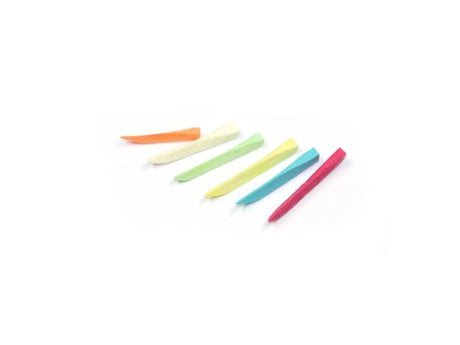
Cotisen
Very low stock (2 units)Regular price LE 179.00 EGPUnit price /Unavailable
TOR VM
Very low stock (1 unit)Regular price LE 149.00 EGPUnit price /Unavailable

How to Choose Wooden Dental Wedges for Your Practice
- Wood Species (Pine vs Birch) — Pine wooden wedges are softer and compress more easily into narrow embrasures, providing lower insertion force; birch wedges are denser, retain their shape better under sustained occlusal force during composite packing, and have a slower moisture absorption rate. For wide embrasures with open contacts, birch wedges are preferred; for tight narrow contacts, pine provides easier insertion with less patient discomfort.
- Moisture-Induced Swelling Mechanism — Natural wood absorbs saliva and blood during the procedure, swelling radially by 5–15% within 2–5 minutes of insertion. This progressive expansion tightens the matrix band-to-tooth seal at the gingival margin, reducing the gingival flash of composite at the restoration margin — an advantage over plastic wedges that do not swell over time.
- Size and Taper Angle — Standard wooden wedge packs contain 100 pieces in mixed sizes. Ensure the wedge tip width is narrow enough to enter the embrasure; the taper angle must match the embrasure opening angle. Over-tapered wedges lack adequate contact depth and slip out; under-tapered wedges cannot be fully seated to the gingival margin.
- Surface Smoothness — Smooth-finished wooden wedges (Elephant and Cotisen brands) reduce matrix band surface damage during insertion compared to rough unfinished wedges that can score the matrix band and create fold points that compromise the restoration margin.
- Pack Size (100 pcs per pack) — At 100–179 EGP per 100-piece pack, wooden wedges are among the most economical restorative adjuncts available in the Egyptian dental market. A single-chair practice performing 4–6 class II composites per day will exhaust one 100-piece pack in approximately 4–5 weeks.
Wooden Wedge Products Available in Egypt
| Brand | Pack Size | Wood Type | Price (EGP) |
|---|---|---|---|
| Cotisen Wooden Wedges | 100 pcs | Pine | 179 |
| TOR VM Wooden Wedges | 100 pcs | Birch | 149 |
| Elephant Wooden Wedges | Standard pack | Pine | 100 |
Availability & Delivery in Egypt
MedSTA supplies wooden dental wedges from Cotisen, TOR VM, and Elephant in EGP with same-day dispatch from Cairo. Cairo and Giza delivery within 1–3 business days; all other Egyptian governorates within 3–5 business days.
Frequently Asked Questions
What is the clinical advantage of wooden wedges over plastic wedges in composite restorations?
What is the clinical advantage of wooden wedges over plastic wedges in composite restorations?
The key clinical advantage of wooden wedges is progressive moisture-induced swelling: natural wood absorbs oral fluids over 2–5 minutes after insertion, increasing radial diameter by 5–15% and tightening the matrix band-to-tooth contact at the gingival margin. This progressive adaptation reduces composite flash at the gingival box floor, which is the most common marginal defect in class II restorations. Plastic wedges maintain constant diameter throughout the procedure and do not self-adapt over time.
Should I use wooden or plastic wedges with a sectional matrix system?
Should I use wooden or plastic wedges with a sectional matrix system?
Sectional matrix systems (Garrison, Triodent) are typically designed for use with the manufacturer’s matched plastic wedges or ring-stabilised configurations. Wooden wedges can be used with sectional matrices when no ring is present, but their variable swelling profile makes them less predictable with tight sectional band fits. For conventional full-arch matrices (Tofflemire, AutoMatrix), wooden wedges are an economical and clinically effective choice in Egyptian general dental practice.
How do I prevent a wooden wedge from breaking during insertion?
How do I prevent a wooden wedge from breaking during insertion?
Wedge fracture during insertion occurs when the wedge tip is forced into an embrasure that is too narrow for the selected size. Wet the wooden wedge briefly in water or saline before insertion to increase surface lubricity and reduce the initial insertion force required. If resistance is high at the gingival entry, use the next smaller wedge size. Never force a dry, full-size wedge into a tight contact as the tip will split and may require retrieval from the subgingival sulcus.
Can wooden wedges be reused or autoclaved between patients?
Can wooden wedges be reused or autoclaved between patients?
No — wooden dental wedges are single-use consumables and must not be reused between patients. Wood is a porous material that cannot be sterilised by autoclaving or chemical disinfection without degrading its structural integrity. After use, the wedge is contaminated with blood, saliva, and composite resin and must be discarded as clinical waste. Never use a wedge from one patient in another patient's procedure regardless of apparent cleanliness.
Does MedSTA supply wooden dental wedges from Cotisen, TOR VM, and Elephant across Egypt?
Does MedSTA supply wooden dental wedges from Cotisen, TOR VM, and Elephant across Egypt?
Yes — MedSTA supplies 100-piece wooden wedge packs from Cotisen, TOR VM, and Elephant in EGP with same-day dispatch from Cairo. Cairo and Giza delivery within 1–3 business days; all other Egyptian governorates within 3–5 business days. Monthly supply orders are available for Egyptian dental practices.